Car Detailing Prices 2026: What to Charge and How to Price Your Packages
Typical car detailing prices for 2026, a simple pricing formula, how to build three packages customers love, and how to show your prices on your website.
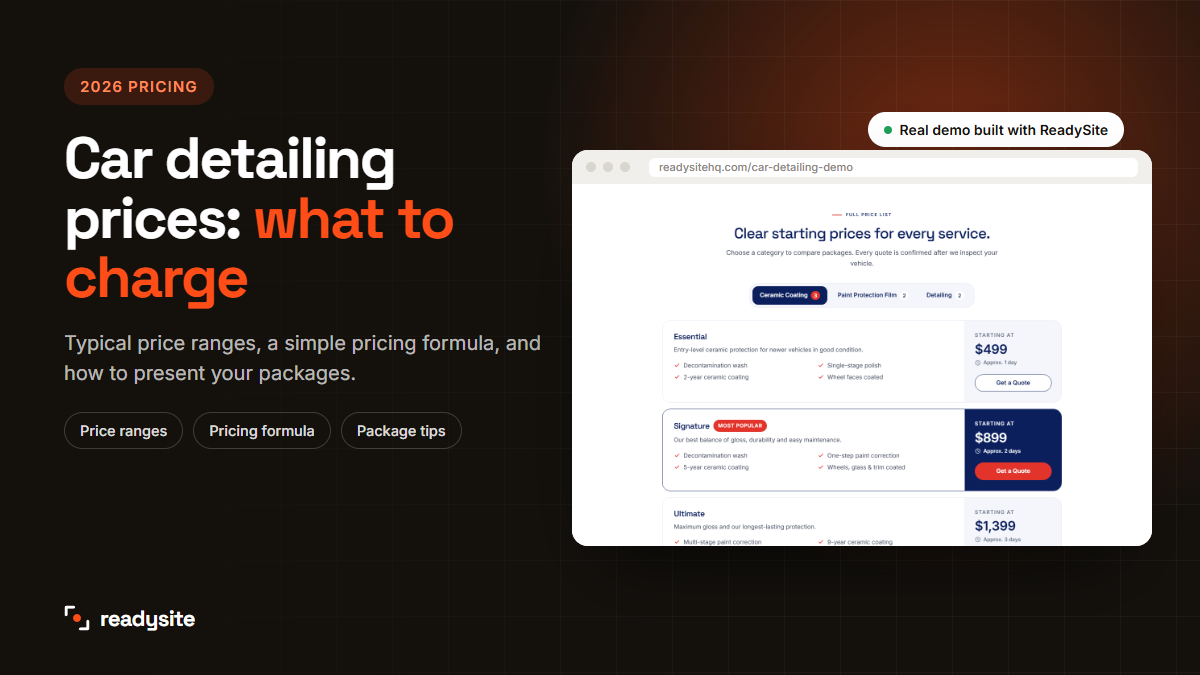
Setting your car detailing prices is one of the hardest parts of running a detailing business. Charge too little and you work long days for nothing. Charge too much without explaining why, and customers go elsewhere. The answer is a clear pricing formula, sensible detailing packages and a website that presents them well.
In this guide you’ll find typical car detailing prices for 2026, a simple formula to work out what you should charge, how to build three packages customers love, and how to show your detailing prices on your website so people book instead of bouncing.
In this guide
Typical car detailing prices in 2026
Prices vary a lot by city, vehicle size, condition and whether you’re mobile or in a shop. Still, it helps to know the usual ranges. Here’s what detailers in the US commonly charge, based on published guides from Jobber, Housecall Pro and other industry sources.
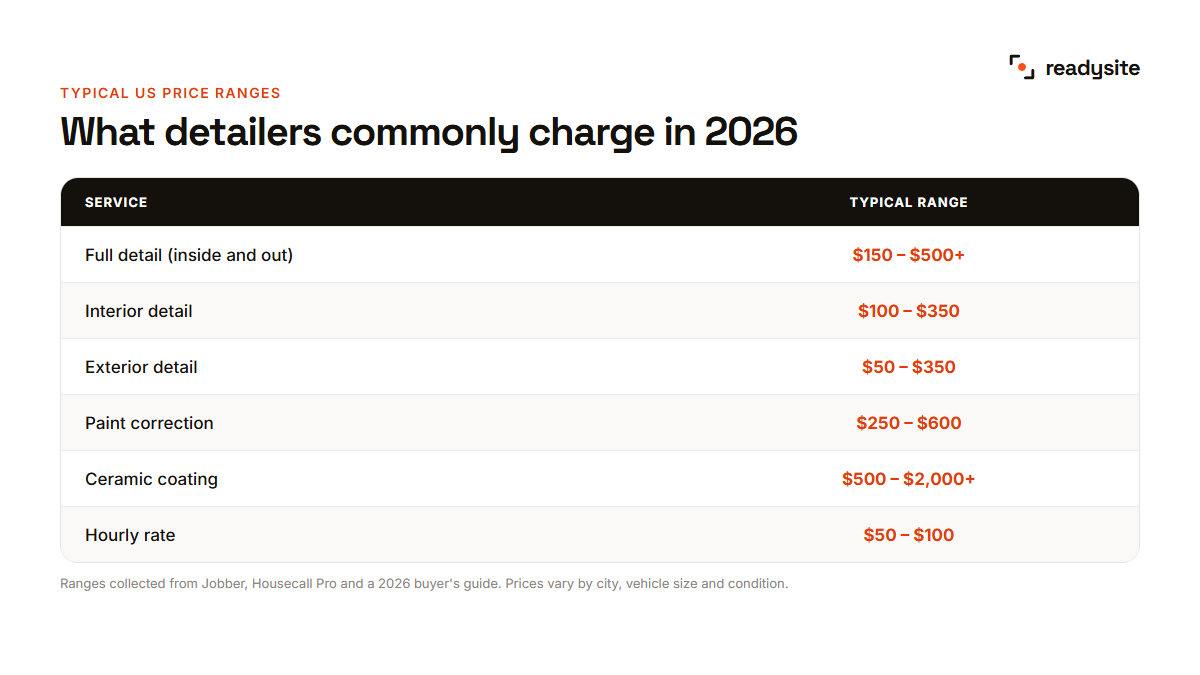
- Full detail (inside and out): about $150 to $500 or more.
- Interior detail: about $100 to $350.
- Exterior detail: about $50 to $350.
- Paint correction: about $250 to $600, more for multi-stage work.
- Ceramic coating: about $500 to $2,000 or more, depending on the coating and prep.
- Hourly rate: many detailers work out to roughly $50 to $100 an hour.
Treat these as a starting point, not a rule. The right car detailing prices for you depend on your costs, your market and the quality of your work.
What affects car detailing prices
- Vehicle size. A large SUV or pickup takes much longer than a small hatchback.
- Condition. Pet hair, heavy stains, mould, oxidation and swirl marks all add time.
- Service level. A maintenance wash and a multi-stage paint correction are completely different jobs.
- Products. Professional coatings and premium products cost more and are worth charging for.
- Location. City detailers usually charge more than those in smaller towns.
- Mobile or shop. Mobile detailers need to cover fuel, travel time and setup.
A simple formula for pricing your detailing services
Instead of copying a competitor’s price list, work out what each job actually costs you, then add profit. It’s the same approach recommended by most detailing business guides.
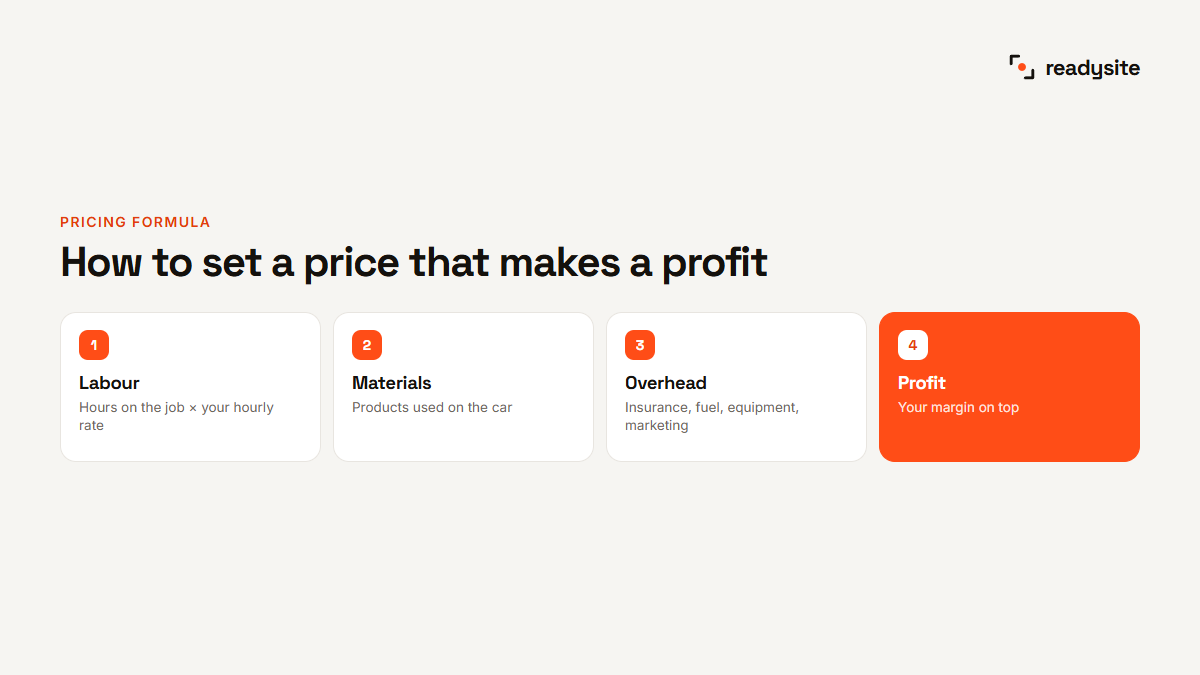
- Labour: how many hours the job takes, multiplied by the hourly rate you want to earn.
- Materials: the products you use on that car, such as shampoo, clay, polish, sealant or coating.
- Overhead: a share of your fixed costs, like insurance, equipment, fuel, phone, software and marketing.
- Profit: your margin on top, so the business can grow and you can replace equipment.
Here’s a simple example. A full detail takes you 4 hours. You want to earn $40 an hour for your time ($160), products cost about $20, and you set aside $25 per job for overhead. That’s $205 before profit. Add a healthy margin and a price of around $249 makes sense. If competitors in your area charge much less, compete on quality and proof, not by cutting your price below cost.
How to build detailing packages customers love
Most customers don’t want to build their own detail from a list of 20 services. They want to pick a package. Three tiers work best, often called good, better and best.
Tier 1: a quick refresh
A lower-priced entry package, such as an express wash, wheels and a quick interior vacuum. It’s perfect for regular maintenance and for nervous first-time customers.
Tier 2: the full detail
Your main package, covering a proper inside-and-out deep clean, with clay bar and sealant. Mark it “Most popular”. Most customers choose the middle option, so make it your best-value package.
Tier 3: showroom or premium
A high-end package with paint correction, a ceramic spray coating, engine bay clean and headlight restoration. Even if few people buy it, it makes your middle package look like great value.
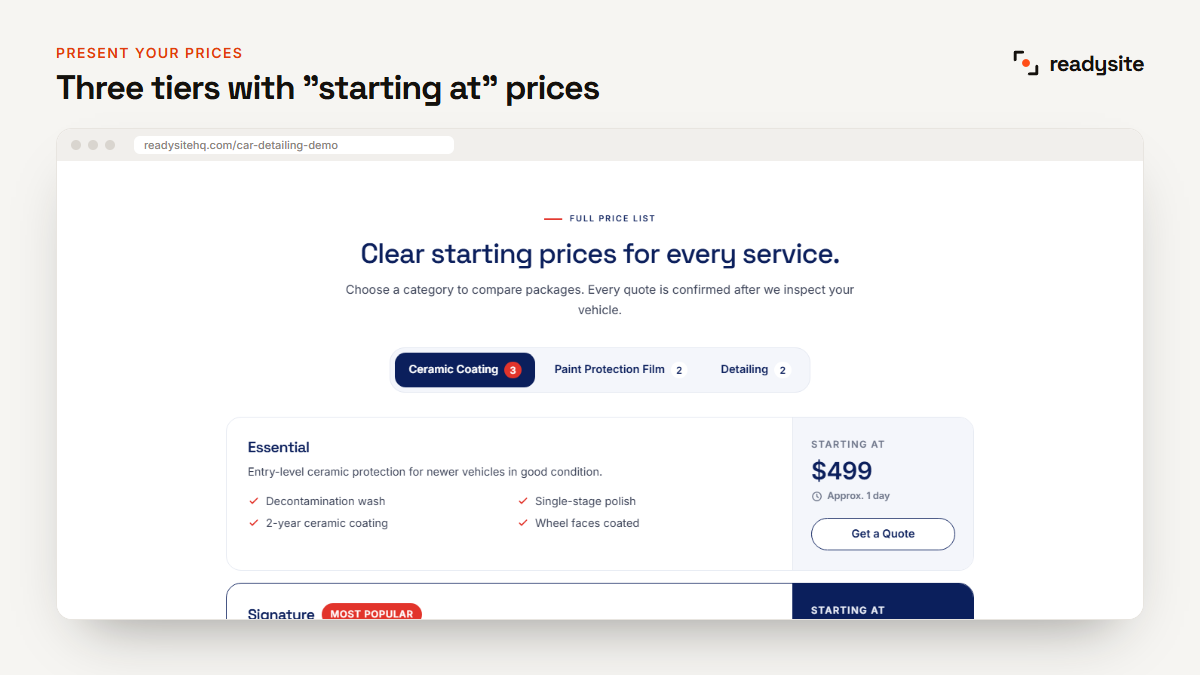
For bigger services like ceramic coating and paint protection film, you can use the same three-tier idea within that category, such as Essential, Signature and Ultimate coatings with different durability.
Add-ons: raise the average job value
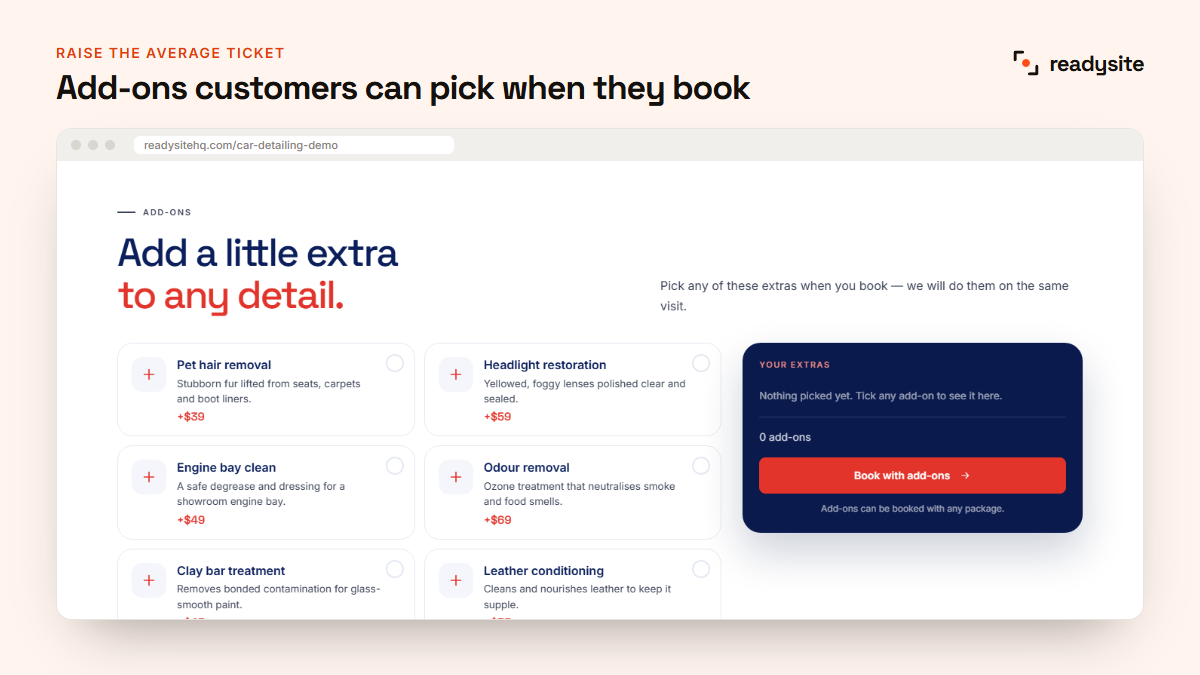
Add-ons let customers customise their detail and raise your average ticket without changing your main detailing packages. Popular ones include:
- Pet hair removal
- Engine bay cleaning
- Headlight restoration
- Odour removal or ozone treatment
- Leather cleaning and conditioning
- Glass coating
- Wheel and caliper coating
- Clay bar treatment
Show each add-on with a short description and a fixed price, so customers can tick them off when they book.
How to price by vehicle size
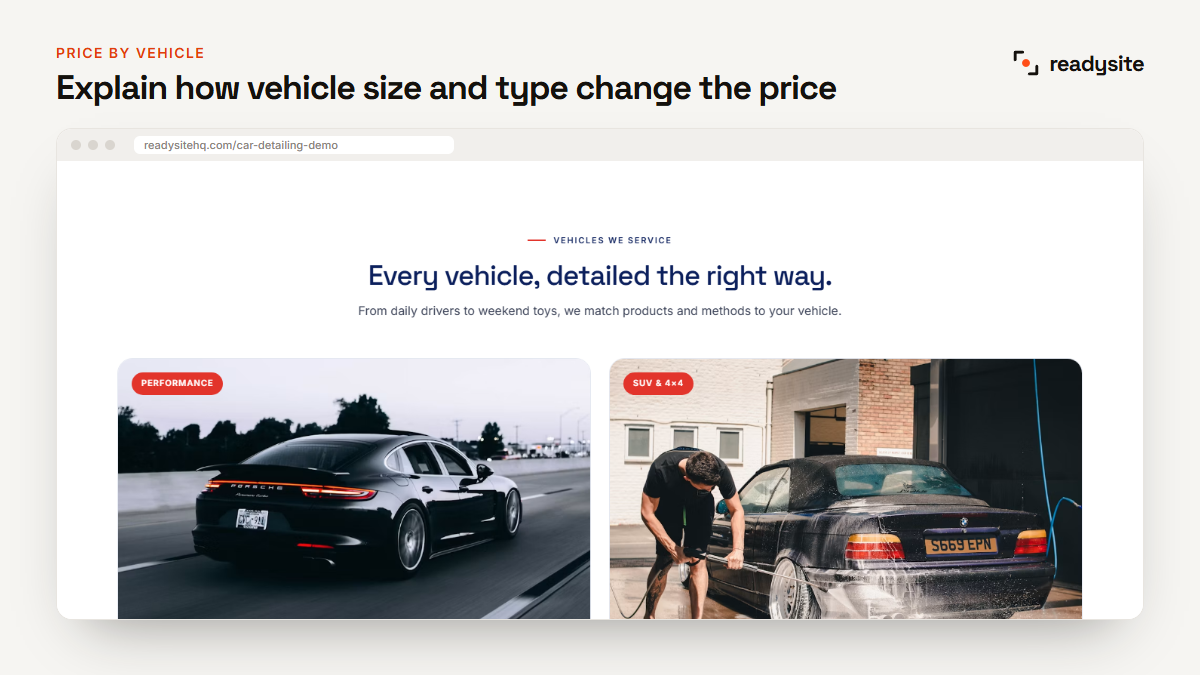
The cleanest approach is to show your car detailing prices for a standard car, then add a simple surcharge for larger vehicles. For example: “Prices shown for cars. SUVs and 7-seaters +$30, vans and pickups +$50.” Some detailers prefer separate columns for car, SUV and truck. Either works, as long as it’s clear before the customer books.
Maintenance plans: steady monthly income
A maintenance plan is a monthly or bi-monthly subscription for regular washes and touch-ups. It keeps customers’ cars looking great after a full detail or coating, and gives you predictable income. Offer two or three plans with clear monthly prices, and include something extra in the higher plans, such as an interior refresh or a spray sealant top-up. Pitch them right after a big job, when the customer can see the difference.
Mobile detailing prices vs shop prices
Mobile detailers and shops often charge similar car detailing prices for the same work, but their costs are different, so the way they build those prices should be too.
Mobile detailers
You save on rent, but you pay for fuel, a van, a water tank, a generator and the time spent driving between jobs. Build those costs into your prices, or set a main service area with no extra charge and add a small travel fee beyond it. Customers usually happily pay a little more for the convenience of not leaving home.
Shops and studios
Your rent, utilities and equipment are bigger fixed costs, so you need a steady flow of jobs to cover them. In return you can offer work that’s hard to do on a driveway, such as multi-stage paint correction, ceramic coating in a dust-free space and paint protection film. These are where shops can charge premium detailing prices.
An example price list you can adapt
Here’s a simple, realistic structure many detailers use. Replace the numbers with your own, based on the pricing formula above and your local market.
- Express Detail, from $129: hand wash, wheels and tyres, interior vacuum and wipe-down, streak-free glass.
- Full Detail, from $249 (most popular): everything in Express, plus clay bar, hand-applied sealant, carpet and upholstery shampoo, door jambs and leather care.
- Showroom Detail, from $449: everything in Full, plus one-step paint correction, ceramic spray coating, engine bay clean and headlight restoration.
- Add-ons: pet hair removal from $35, engine bay from $45, headlight restoration from $79.
- Maintenance plans: from $39 a month for a monthly maintenance wash.
Notice that each package clearly builds on the one before it. That makes the step up easy to understand and easy to sell.
Pricing ceramic coating and paint correction
Premium services need a slightly different approach because the time, skill and products involved vary so much from car to car.
- Price by protection level. Offer coatings by durability, for example 2-year, 5-year and longer-lasting options, and explain the difference in plain words.
- Include the prep. Most coating jobs need decontamination and some paint correction first. Build that into the package so customers aren’t surprised.
- Show how long it takes. “Approx. 1 day” or “Approx. 3 days” helps justify the price and sets expectations.
- Inspect before confirming. Show a “starting at” price online, then confirm the final quote once you’ve seen the paint.
One 2026 buyer’s guide puts paint correction at roughly $250 to $600 and coatings at $500 to over $2,000, which shows how wide the range is. Your reviews, photos and the products you use are what let you charge at the upper end.
How to quote for very dirty or unusual vehicles
Some cars take twice as long as others in the same package. Protect your time with simple, upfront rules:
- Add a clear “heavy soiling” surcharge for excessive pet hair, mould, sand or biohazards.
- Ask for a couple of photos before booking, especially for interiors. WhatsApp makes this easy.
- Quote classic cars, exotics and modified vehicles individually.
- Explain any extra charge before you start, never after.
How to talk about price with customers
Many detailers lose jobs not because of the price, but because of how they talk about it. A few tips:
- Lead with the result, not the cost. “Your paint will look glossier than the day you bought it, and it’ll be protected for two years” comes before the number.
- Offer a choice. Three options feel like a decision about which, not whether.
- Don’t apologise. Say your price confidently and explain what’s included.
- Know your floor. If someone wants a cheaper price, remove services rather than discounting the same work.
How to show detailing prices on your website
How you present your prices matters as much as the numbers. A clear price section builds trust and turns visitors into bookings.
- Show “from” or “starting at” prices. You don’t need to cover every possible job, just give people a realistic idea.
- List what’s included in each package, using plain words.
- Highlight your most popular package so people know where to start.
- Add a short note such as “Final price confirmed after we see your vehicle”.
- Put a booking button right next to every package.
- Show how long each service takes, so customers can plan their day.
If you’d like a website that already has packages, add-ons and maintenance plans laid out like this, ReadySite builds one for car detailers in under a minute. Read our guide to car detailing website design to see every section.
How to check competitors’ detailing prices
Your costs set your minimum, but your local market tells you what customers expect to pay. Spend half an hour checking five or six detailers in your area:
- Look at their websites and Google profiles for published detailing packages and prices.
- Note what’s included in each package, not just the price.
- Check their reviews and photos. Higher prices usually come with stronger proof.
- See whether they’re mobile or shop-based, and what areas they cover.
You don’t need to be the cheapest. Aim to be the clearest and most trustworthy. A detailer with transparent car detailing prices, great photos and lots of reviews can charge more than a competitor who hides everything behind “call for a quote”.
Pricing fleet and commercial work
Fleet work for vans, company cars, taxis or dealerships is usually priced lower per vehicle, but it’s regular, predictable and often grouped in one location. That makes it valuable for filling weekdays.
- Offer a per-vehicle rate with a minimum number of vehicles per visit.
- Agree a regular schedule, such as weekly or monthly, and invoice monthly.
- Keep a short, fixed list of what’s included, so every visit is quick and consistent.
- Charge extra for one-off deep cleans or signage-safe washing.
Seasonal offers and gift cards
Rather than cutting your detailing prices when things are quiet, add value. Offer a free add-on in slower months, bundle a coating with a maintenance plan, or sell gift cards before the holidays. You keep your normal prices, customers feel they’re getting a deal, and you get paid upfront for gift cards.
When and how to raise your prices
If your calendar is full weeks ahead, you’re probably undercharging. Signs it’s time to raise your car detailing prices:
- You’re booked solid and turning work away.
- Your product and fuel costs have gone up.
- Your reviews and skills have improved since you set your prices.
- Almost nobody questions your prices.
Raise prices for new customers first, give regulars a heads-up, and update your website and Google profile on the same day. Explain what’s included rather than apologising for the price.
Car detailing pricing mistakes to avoid
- Copying the cheapest competitor. Price from your costs and your quality.
- Not charging for condition. Pet hair and heavy stains should cost extra.
- Too many packages. Three is easier to choose from than eight.
- Hiding prices. “Call for a quote” loses customers who just want a rough idea.
- Forgetting travel time. Mobile detailers should build fuel and drive time into prices or charge a travel fee outside their main area.
- Constant discounting. One clear first-time offer is enough.
Frequently asked questions
How much should I charge for a full car detail?
Many detailers charge somewhere between $150 and $500 for a full detail, depending on vehicle size, condition and location. Use the pricing formula above to make sure your price covers your time, products and overhead with a profit on top.
Should I show prices on my detailing website?
Yes. Showing starting prices builds trust and brings in customers who are ready to book. Add a note that the final price is confirmed after you see the vehicle.
How many detailing packages should I offer?
Three main packages work best for most detailers, plus a short list of add-ons and, if you like, two or three maintenance plans.
Should mobile detailers charge more?
Often, yes. Mobile detailers cover fuel, travel time and equipment, and customers value the convenience. Many build those costs into their car detailing prices or add a travel fee outside their main area.
Should I list prices for every vehicle type?
Not necessarily. Many detailers show prices for a standard car and add a clear surcharge for SUVs, vans and trucks. That keeps the price list short and easy to read.
How often should I review my prices?
At least once a year, and whenever your product, fuel or insurance costs change noticeably. If you’re booked solid for weeks, review them sooner.
Should I take a deposit?
Many detailers take a small deposit for long jobs like ceramic coating and paint correction, so a no-show doesn’t cost them a full day. For quick services, a deposit is usually optional.
Present your prices like a pro
Remember: the goal isn’t to be the cheapest detailer in town. It’s to charge a fair price that pays you properly, and to make that price easy to understand and easy to book. Work out your costs, build three clear packages, add a few add-ons and plans, and put it all on your website.
Clear car detailing prices and well-built detailing packages are one of the fastest ways to win more bookings. Build your free car detailing website with packages, add-ons and plans already laid out, then use these marketing ideas to fill your calendar.