Detailing Business Insurance: A Plain-English Guide to the Coverage You Need
What general liability, garagekeepers, commercial auto, tools coverage and workers' comp mean for detailers, the common gaps, and the questions to ask an agent.


Detailing business insurance usually starts with general liability, which covers injury and property damage claims from your work, plus coverage for customer vehicles while they’re in your care, often called garagekeepers or care, custody and control coverage. Add commercial auto for the vehicle you work from, equipment coverage for your tools, and workers’ compensation once you hire. Which of these you need, and at what limits, depends on your state, your services and how you operate.
This plain-English guide explains each coverage type detailers ask about, the gaps that catch new owners out, and the questions to ask an agent so you can compare quotes on the same terms. We don’t quote premium figures, because prices depend on your state, limits, vehicle and history; the only reliable number is a real quote. This is general information, not insurance or legal advice. Policy wording decides what’s covered, so read your policy and ask a licensed agent about your situation.
No website yet? Our car detailing website builder makes one from two answers, free, with call, text and quote buttons ready for phone visitors.
Why Detailing Business Insurance Matters
Detailing looks low risk until you list what can go wrong. You work on cars worth tens of thousands of dollars, often in someone else’s driveway, with chemicals, pressure washers, polishers, water and extension cords. Without coverage, a single claim could cost more than months of revenue, which is a hard hit for a small, owner-run business.
Ordinary Accidents On Expensive Cars
Most claims against a general liability or garagekeepers policy don’t come from dramatic events. They come from everyday slips that happen to careful people. A customer slips on a wet driveway. A polisher touches a panel edge for a second too long. A chemical leaves a stain on a leather seat. A car rolls into a garage door because the parking brake wasn’t fully set. Each of these is an ordinary accident, and each can turn into a bill that’s far bigger than the price of the detail you were doing that day.
Clients Ask For Proof Of Insurance
Insurance also affects who will hire you. Dealerships, fleet managers, property managers and many homeowners ask for proof of insurance before they let you work on their vehicles or their property. Without it, some of the steadiest accounts in your area are simply closed to you. The SBA’s guide to business insurance puts the general rule simply: insure against losses you couldn’t pay for yourself. For most detailers, damage to a customer’s car is exactly that kind of loss, and it’s the reason garagekeepers comes up in almost every conversation with an agent.
Get Quotes Before Your First Paid Job
If you’re still setting up, start on your detailing business insurance early. Quotes can take a while, especially when the agent needs details about your services and vehicle, and coverage should be active before your first paid job, not after it. Booking a customer and then scrambling for a policy the night before is stressful and leaves no time to compare options. Our roadmap to start a mobile detailing business shows where insurance fits in the full launch sequence.
Done-for-you websites
Want your website built for you?
ReadySite writes the wording, builds up to 5 pages and sets up your Google Business Profile. $299 one time, and you see a free preview before you pay.
What Insurance Does A Detailing Business Need?
Five coverages come up again and again when detailers talk to agents. The overview below shows what each is for and what to check, and the subsections explain them in more detail. Treat it as a map for your conversation with an agent, not as a final answer about what any policy covers.

General Liability
General liability is the foundation of most policies. The NAIC’s small business insurance guide describes commercial general liability as covering bodily injury, damage to other people’s property, personal injury such as slander and libel, and false or misleading advertising claims. It also notes what it doesn’t cover: employee injuries, vehicle claims and professional errors need other policies. For a detailer, general liability might respond to a customer who trips over your hose, or overspray that damages a neighbor’s fence.
Ask how the general liability policy treats work done at customer locations, and whether it includes “completed operations,” which can matter for damage discovered after you leave.
Garagekeepers And Care, Custody And Control
This is the coverage detailers most often misunderstand. Many liability policies exclude damage to property in your “care, custody or control,” and a customer’s car you’re working on can fall under that exclusion. An Insurance Journal explainer on garagekeepers describes it as optional coverage that buys back protection for customer vehicles. It describes three forms: legal liability, which pays when you’re legally responsible; direct primary, which pays regardless of fault; and direct excess, which pays regardless of fault but only after the owner’s own insurance.
Ask which form a quote includes and whether it applies when you work at a customer’s home, since garagekeepers was designed around garage operations. Some insurers offer care, custody and control as an endorsement instead; the label matters less than the wording.
Commercial Auto And Tools Coverage
Your work vehicle carries equipment, water and chemicals from job to job. The NAIC guide warns that business-related liability may be excluded from personal auto policies, so tell your insurer how you use the vehicle and ask whether you need a commercial policy or an endorsement. Ask about towing a trailer, too. Pressure washers, extractors, polishers and generators are expensive, and theft from a vehicle may not be covered by your auto policy. Agents often handle this with inland marine or contractor’s equipment coverage, which follows your tools.
Keep an equipment list with serial numbers, prices and photos to support any claim; our mobile detailing equipment guide includes a simple log format.
Workers’ Compensation And Other Coverages
The moment you hire help, workers’ compensation becomes a key question. The NAIC guide says it’s required in nearly all states, and most states require it even with one employee. Rules on owners, part-time workers and contractors vary by state, and calling a helper a “contractor” doesn’t automatically make them one. An agent may also discuss a business owner’s policy, an umbrella policy for higher limits, property cover if you rent a bay, and cyber coverage if you store customer data. Homeowners policies are rarely adequate for business use.
You may not need every one of these on day one. What matters is knowing which risks each policy handles, so you can decide on purpose rather than discover a gap when something goes wrong.
Common Gaps And Which Policy Responds
Most surprises come from assuming something is covered when it isn’t. The scenarios below are illustrative and simplified. In real life, the answer depends on your policy wording, your state and the facts, so use them to prepare questions for your agent, not to predict how any claim would turn out.
Damage To The Car You’re Working On
Say your polisher burns through clear coat on a customer’s car. That’s the claim many detailers worry about most, and it’s the one general liability alone may not handle. It usually involves garagekeepers or care, custody and control coverage, so confirm that coverage in writing. Some policies also limit cover for “faulty workmanship,” so ask specifically how damage caused by your own work is treated. Then ask about gray areas, like a car damaged by a falling branch at your rented bay, where direct forms may respond and legal liability forms may not.
Your Vehicle, Your Tools And Your Helpers
If you rear-end another car driving to a job, commercial auto usually responds, or your auto policy if business use is disclosed and covered. A personal policy may exclude business use, so be open about how you drive. If your extractor is stolen from your locked vehicle, tools coverage is usually involved; check theft from a vehicle and the deductible. If a helper strains their back lifting a water tank, that’s workers’ compensation, and uninsured helpers or subcontractors can leave you exposed, so ask about certificates of insurance.
Specialty Services, Low Limits And Bonds
Paint correction, ceramic coatings, tinting or wraps may change how an insurer classifies your business or need specific wording, so tell your agent everything you offer. A limit that sounds big can be small against a luxury car or an injury claim; ask what limits commercial clients in your area typically require. Also note what insurance isn’t. A surety bond, which some cities or clients may ask for, is different from insurance, and “bonded and insured” on your website should only appear if both are true.
If you only remember one gap, make it this one: general liability and garagekeepers do different jobs. One responds to injury or damage you cause to other people and their property. The other responds to damage to the customer’s vehicle while it’s in your care. Most detailers who work on customer cars every day ask about both, and many need both.
Gaps like these rarely show up in the headline price of a quote. They live in exclusions, definitions and limits, which is why the next step is asking the same questions of every agent and getting the answers in writing.
How To Shop For Detailing Business Insurance
Shopping is easier when you prepare the same information for every quote. It also helps the agent classify your business correctly, which affects both price and coverage. The four steps are simple: list your work, get at least three quotes, compare them line by line, and review your cover every year.

What To Have Ready
Before you call anyone, write down your business structure, name and address, and the year you started. List every service you offer now and plan to offer in the next year. Note where you work: customer homes, workplaces, dealership lots or a rented bay. Add your vehicle details and whether you tow a trailer, your equipment list with approximate values, and your expected annual revenue and payroll. The NAIC notes that liability premiums are often linked to sales and payroll estimates, so rough numbers help.
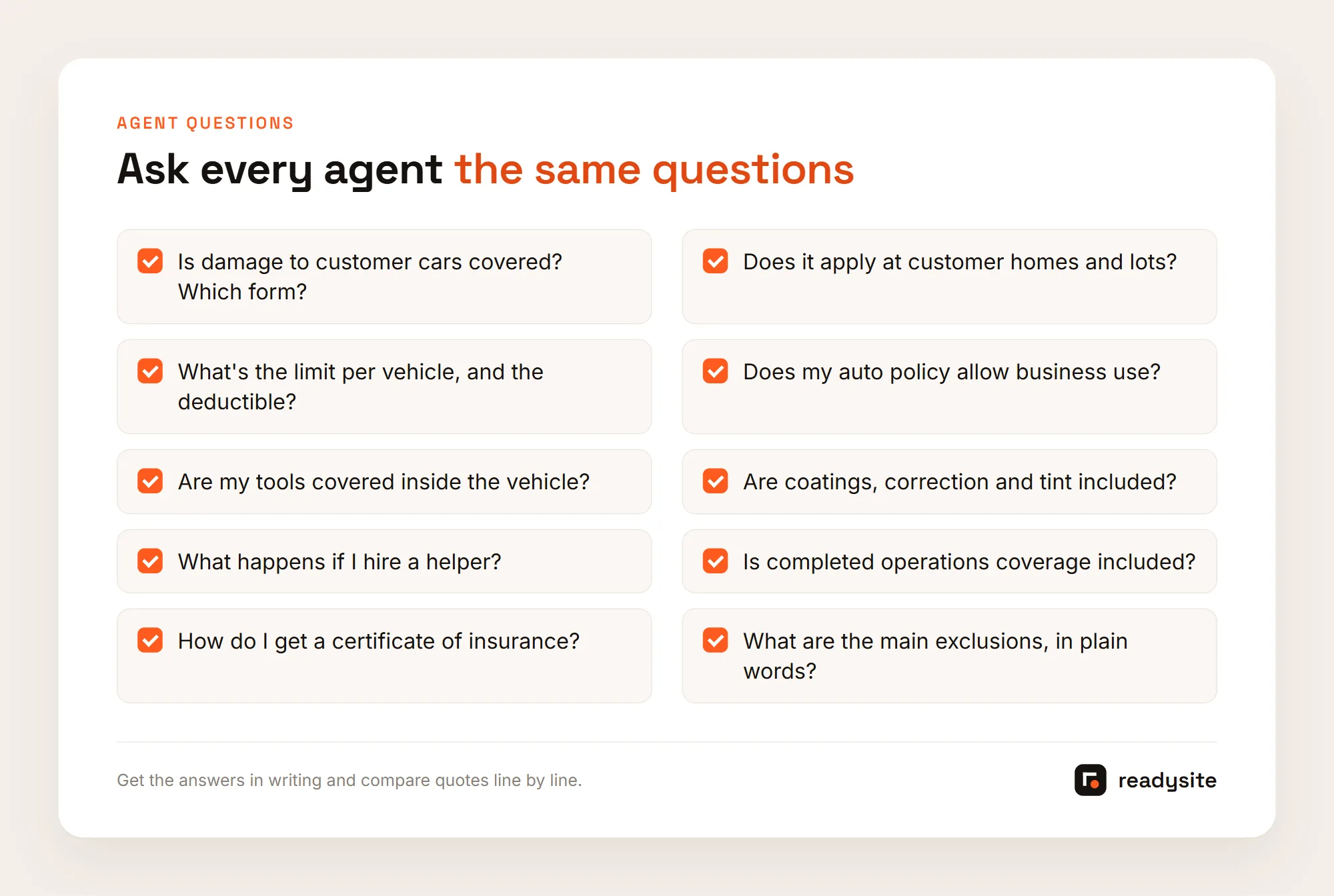
Questions To Ask Every Agent
The fastest way to compare detailing business insurance quotes fairly is to ask every agent the same questions and note the answers. Ask each one to explain exclusions in plain words, not just limits and price. A cheaper quote that excludes customer vehicles isn’t cheaper if you scratch a car in the first month. If an answer is vague, ask the agent to point to the policy language. To check that an agent or insurer is licensed, use the NAIC’s directory of state insurance departments.
Compare Like With Like
Put each quote in a simple table with the same rows: general liability limits, garagekeepers form and limit, deductible for customer vehicles, commercial auto, equipment coverage, workers’ compensation and total price. Example (illustrative): Quote A is cheaper and includes general liability only. Quote B costs more but adds legal liability garagekeepers with a stated limit per vehicle, plus tools coverage. For a detailer who works on customer cars every day, Quote B covers the most likely claim and Quote A doesn’t. The cheaper quote isn’t the better deal.
Review Your Coverage Every Year
Your coverage should grow with the business. Set a yearly reminder to review your detailing business insurance, and call your agent sooner if you add ceramic coatings or tint, hire a helper, buy a van or trailer, rent a bay, or sign a fleet or dealership account. Each of those changes can affect what you need and what your current policy covers. An outdated policy is one of the easiest gaps to miss, because nothing feels different until a claim arrives and the wording no longer matches your work.
A little preparation turns insurance shopping from a confusing sales call into a straightforward comparison. Keep your notes, quotes and final policy together so next year’s review starts from what you already know.
How To Reduce Claims And Use Proof Of Insurance
Insurance is the backstop. Good habits are the first line of defense, and they help if a claim does happen, because you’ll have records to show what you did. Once you’re covered, insurance also becomes a selling point that helps you win work.
Walk Around The Car And Write Down Your Terms
Walk around every car before you start. Note existing scratches, chips, curb rash and interior wear, and photograph them with the customer present if possible. Then put your terms in writing. Your confirmation text or quote should state what’s included and how you handle pre-existing damage, and an attorney should review any waiver or terms language. Our detailing quote template includes a section for condition notes you can adapt, so the record is created as part of every booking.
Test, Label, Secure And Train
Try chemicals and pads on an inconspicuous spot first, especially on leather, delicate trim or soft paint. Keep safety data sheets, know what’s in every product, and keep containers labeled. Tie down tanks and equipment, and lock tools out of sight. Before any helper works on a customer car, show them your process and your limits. These habits won’t eliminate risk, but they reduce how often you need your policy and make your business easier to insure. A clean claims history can also matter at renewal.
Certificates And Additional Insured Requests
Many customers want to know a detailer is insured before they hand over keys, and commercial clients often require proof. Ask your agent how to request a certificate of insurance for a client, and what it means to add a client as an “additional insured” if they ask. Fleet and dealership accounts commonly require both, and the process is usually quick once you know who to call. Our guide to fleet detailing contracts covers what those clients look for before they sign.
Show Your Coverage On Your Website
On your website and Google profile, a short line such as “Fully insured, certificate available on request” answers the question before customers ask. Be accurate and say only what your policy actually covers. When you build your detailing website free with ReadySite, add that line near your services and contact buttons, where customers decide whether to call. The free plan includes click-to-call, a WhatsApp button and a quote form, so an insured, trustworthy business is also an easy one to contact.
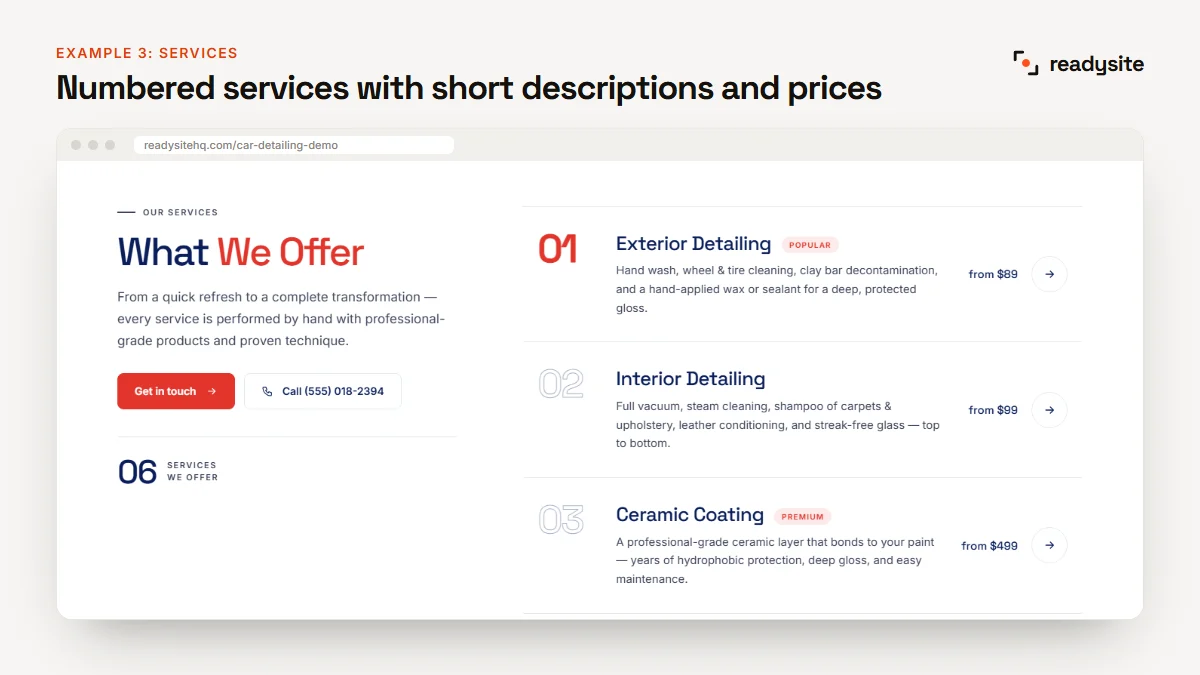
Safe habits protect your customers’ cars, and visible proof of coverage protects your bookings. Together they make your detailing business insurance work harder than a policy sitting in a drawer.
Conclusion
Good detailing business insurance starts with general liability and coverage for customer vehicles, then adds commercial auto, tools coverage and workers’ compensation as your business needs them. Write down every service you offer and every place you work, call at least three agents with the same questions, and compare the quotes line by line, paying most attention to garagekeepers or care, custody and control coverage.
Insurance won’t make you more careful, but it can keep one bad day from ending your business. Once you’re covered, show it. ReadySite’s done-for-you plan builds a site for $299 one time that presents your services, service area and “fully insured” message clearly, and you can request a free preview and decide after you’ve seen it.
Done-for-you websites
Want your website built for you?
ReadySite writes the wording, builds up to 5 pages and sets up your Google Business Profile. $299 one time, and you see a free preview before you pay.