Detailing Quote Template: A Copyable Estimate With Condition Notes, Deposit and Terms
Copy this detailing quote template: customer and vehicle details, condition notes, size-based pricing, add-ons, deposit and terms, plus a photo-based remote quoting process.


A detailing quote template is a one-page written estimate that lists the customer and vehicle, the condition of the car, exactly which services are included, each price line, the deposit, how long the quote is valid and your key terms. You fill it in for each job and send it as a document, an invoice app entry or a text message. It takes a few minutes once it’s set up, and it saves a lot of back and forth later.
This guide covers when a written estimate is worth sending, the eight sections every quote should have, how to write condition notes that prevent disputes, how to quote from photos, and the mistakes that cost detailers money. There’s also a filled-in example with illustrative numbers, so you can see how the parts fit together before you write your own.
Need the website first? You can build a free car detailing website in a few minutes, with your packages, prices and a quote button, or start from a detailing template.
Why A Detailing Quote Template Matters
A quick text with a price is fine for a regular maintenance wash. For bigger jobs like paint correction, coatings, heavily soiled interiors or fleet work, a written quote protects both you and the customer, because everyone can see what was agreed. A saved detailing quote template means you don’t start from a blank page each time, and every customer gets the same clear format.
Fewer Disputes About What Was Agreed
Most arguments in detailing start with “I thought that was included” or “that scratch wasn’t there before.” A written estimate answers both before they come up. It lists what you will do, what you won’t do, and what you saw on the car before you touched it. When the customer accepts it, you both have the same record to point to. That doesn’t make every job smooth, but it turns a he said, she said argument into a quick look at the paperwork.
A Breakdown Stops Haggling
A quote that shows one total and nothing else invites haggling, because the customer has no idea what they’re paying for. When the estimate splits the same total into a package, add-ons, a condition fee and travel, the price makes sense. If the customer wants to spend less, they can remove an add-on instead of asking you for a discount. That keeps your package price intact, and it keeps the conversation about the work rather than about your rate.
When You Need A Written Estimate
Not every job needs a formal document. A regular customer booking their usual detail doesn’t need a new estimate each time. Use a written quote when the job is above an amount you choose, such as anything over your full detail price. Also use one when the price depends on condition, like pet hair, stains, odors or paint defects, or when the work is paint correction, ceramic coating or another multi-hour service.
A written estimate also makes sense when you’re taking a deposit, when the customer is a business, fleet or dealer that needs paperwork, and when you’re quoting from photos without seeing the car. The rest of the time, a short text with a range and two available times is enough. Our guide to responding to detailing leads has templates for those quick replies.
Done-for-you websites
Want your website built for you?
ReadySite writes the wording, builds up to 5 pages and sets up your Google Business Profile. $299 one time, and you see a free preview before you pay.
What Goes In A Detailing Quote Template?
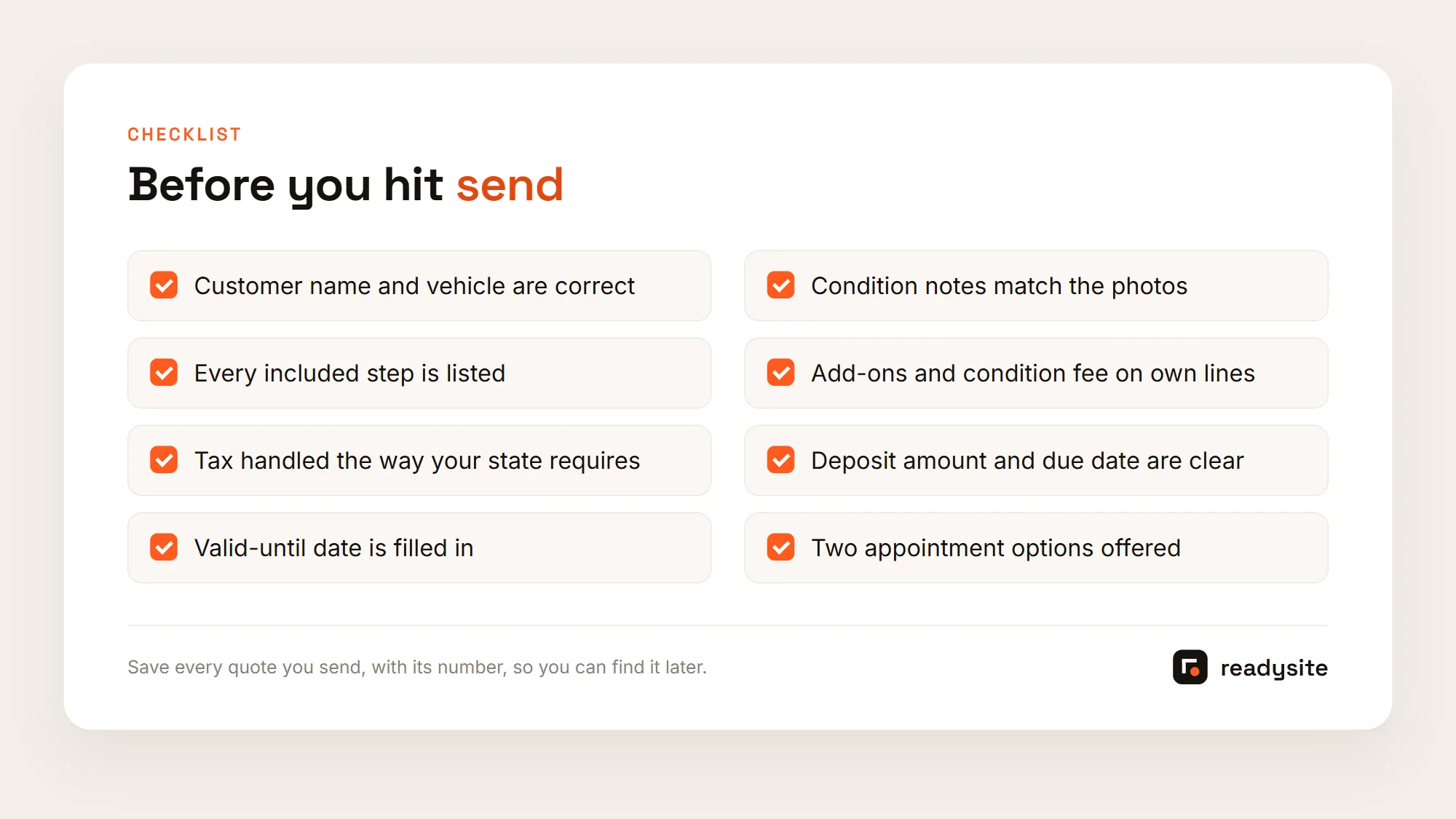
A good quote template has eight sections in the same order every time: header, customer and vehicle, condition notes, services, price, deposit and payment, terms, and acceptance. Keep the headings even when a section is short, so customers learn where to look on every quote you send. If a section doesn’t apply, delete the line rather than writing “N/A” everywhere.

Header, Customer And Vehicle Details
The header holds your business name, phone, email and website, plus a quote number, the date and who prepared it. A quote number sounds formal, but it makes it easy to match a quote to the final invoice later. Under it, add the customer’s name, phone and service address or ZIP code. Then add the vehicle: year, make, model, color and size class, such as car, SUV, truck or van. The size class matters because it usually sets the package price.
Condition Notes And What The Estimate Is Based On
Condition notes describe the interior and exterior as you saw them. For example, “moderate pet hair on rear seats and cargo area; coffee stain on driver seat” or “light swirl marks visible in sun; tar behind wheels.” Add a line for existing damage, like a chip on the hood or a scratch on the rear bumper. Finish with what the estimate is based on: photos received on a certain date, or an in-person inspection. That one line explains why the price might change on site.
Services Included And Not Included
Name the package, then list each step in plain words. “Full Detail” means different things to different people, so spell it out: hand wash, wheels and tires, decontamination, sealant, vacuum, seat and carpet cleaning, plastics, glass and door jambs. Then add a “not included” line for anything customers often assume is part of the job, such as the engine bay or headliner stains. That single line prevents more disagreements than almost anything else on the page.
Price, Deposit, Terms And Acceptance
The price section lists the package for the size class, each add-on, any condition fee with a reason, a travel fee if you charge one, sales tax if it applies, and the total. Below that, state the deposit, when it’s due and that it’s applied to the total, plus the balance due on completion and the payment methods you accept.
The terms section gives the estimate a “valid until” date, says the final price is confirmed on inspection, and covers rescheduling, weather and access. The last section tells the customer how to accept: reply YES to the message, or sign and date the quote. Short, plain terms on every estimate answer the questions that usually cause arguments later, without any legal language.
That’s the whole detailing quote template, and it fits on one page for most jobs. Copy it into your document editor, invoicing app or notes, replace the bracketed parts with your own details, and save it. The sections that need the most care are condition notes and price lines, so the next part covers those in detail.
How To Write Condition Notes And Price Lines
Condition notes are the most important part of any detailing quote template, and the part most owners skip. They record what you saw before you started, which protects you when a customer later questions the result, and they explain why the price is what it is. Price lines do the same job for money: they show where every dollar on the estimate comes from.
Be Specific, Not Dramatic
“Interior very dirty” doesn’t help anyone, and it can sound like a judgment of the customer. “Dog hair embedded in rear seat fabric and cargo carpet; sticky residue in cupholders; light odor” is better. It tells the customer you looked closely, and it explains a condition fee without any blame. Write notes the way you’d describe the car to another detailer who will do the job: plain, factual and specific about where the problem is and how much of it there is.
Note Damage And Set Honest Expectations
List chips, scratches, curb rash, torn seams, cracked trim and warning lights you notice, and take dated photos. On arrival, walk the car with the customer if you can and point them out again before you start. Also say what a detail can’t fix. Deep scratches through the clear coat, permanent dye transfer, sun-faded plastics and old set-in stains may improve but not disappear. A line like “Stain on passenger seat will be treated; full removal is not guaranteed” goes a long way. Customers rarely complain about outcomes they were warned about.
Keep Every Charge Visible
Use the same package names and size classes as your detailing service menu, so the quote matches what the customer saw on your website. Give each add-on its own line with a fixed price. Put any condition fee on its own line with a short reason, like “heavy pet hair,” and never fold it silently into the package price. If you charge travel outside your core area, list it. If you give a discount, show the normal price and the discount separately, so the customer knows the real price for next time.
For typical package prices, see our car detailing prices guide. Coatings work differently, with prep hours, product and warranty, and our guide to ceramic coating pricing explains how to build that estimate. Whatever you charge, the lines on your estimate should add up to the total with no surprises. If a customer asks why the price went up since last time, the lines answer that too.
Check Sales Tax Rules For Your State
Whether detailing services are taxable depends on your state and sometimes your city. Some states tax certain services and others don’t. Check with your state tax agency or an accountant before you add or leave out a tax line. The Federation of Tax Administrators keeps a directory of state tax agencies that makes it easy to find yours. This is not tax advice. Once you know the answer, write it into your quote template so you don’t have to think about it on every job.
Good notes and clear price lines take a few extra minutes per estimate. In return, the customer understands the total before they say yes, and you have a written record if anything is questioned after the job. Both make the next step, quoting without seeing the car, much safer.
How To Quote From Photos And Set Terms
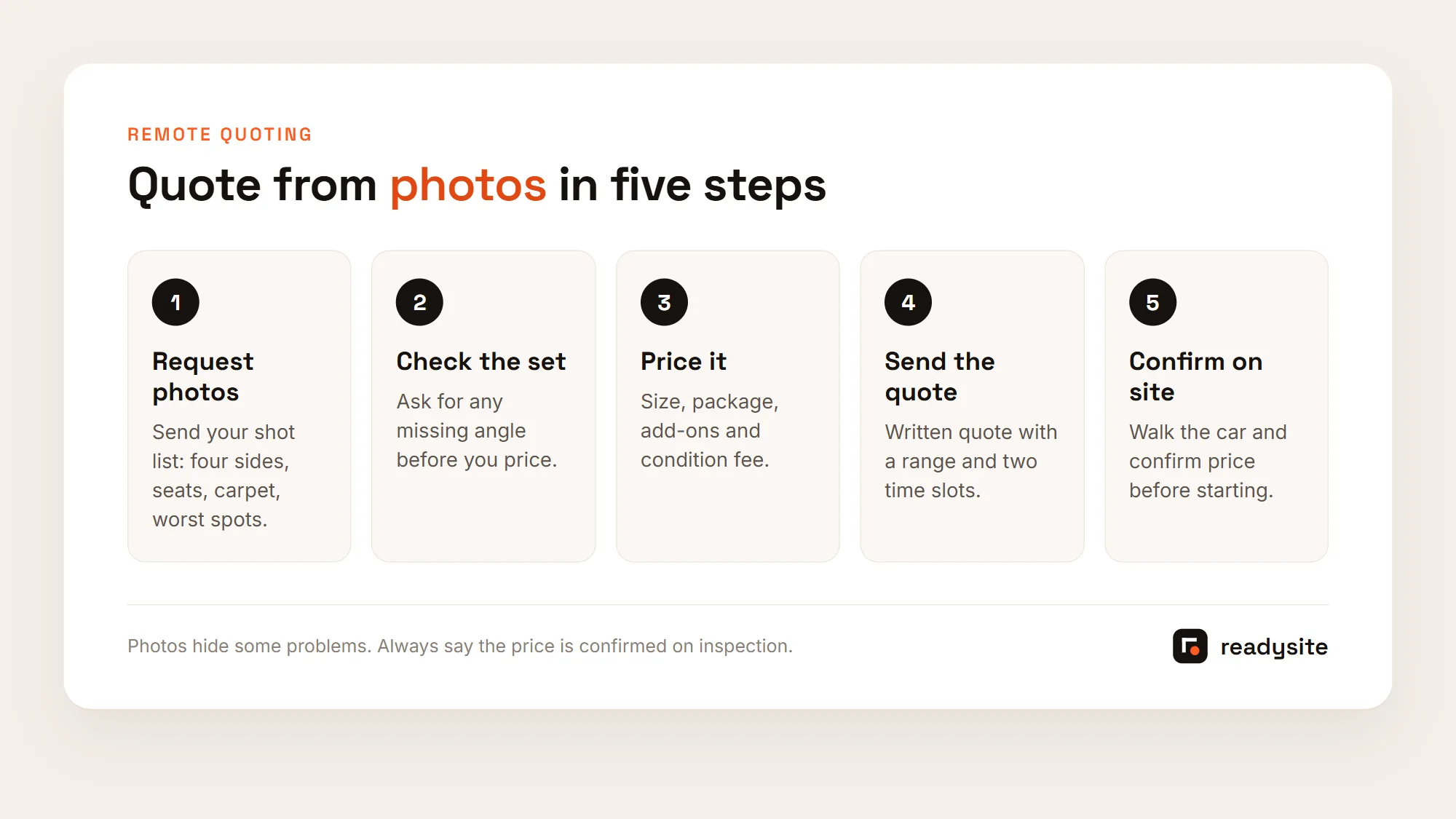
Most mobile detailers quote before they ever see the car. Photos make that possible, but only if you ask for the right ones. A vague “send some pics” gets three flattering shots from the best angle. A short, fixed process for remote quotes, plus clear terms, keeps those jobs predictable.
Send A Photo Shot List
Save a message like this as a text shortcut: “To give you an accurate estimate, please send: front, back and both sides of the car in daylight; the driver seat; the rear seats; the floor carpet; the cargo area; and close-ups of any stains, scratches or problem spots you’d like us to look at.” When the photos come in, compare them against your own condition definitions, such as normal, heavy and extreme, and fill in the condition notes as you go.
A website quote form that asks for photos up front saves a message or two, and it means your first estimate is closer to the final price. Ask for the vehicle, the service they want and their ZIP code on the same form. Our guide to the detailing quote form covers which fields to include.
Price A Range, Then Confirm On Site
Photos hide things: smells, sticky residue, how deep stains go, and how swirled the paint looks in direct sun. For anything that depends on condition, give a range and explain that you’ll confirm the price on site. If the car is clearly worse than the photos, show the customer, explain the difference and agree the change before you start. Never surprise anyone with a higher total at the end of the job. That one rule protects your reviews more than any other.
Deposits, Validity And Weather
Many detailers take a deposit for larger jobs or long appointments, to protect a slot that could have gone to someone else. There’s no standard amount. Choose one you’re comfortable defending, state when it’s due, say it’s applied to the total, and say what happens to it if the customer cancels or reschedules. Give every estimate a “valid until” date, such as 14 or 30 days, so nobody books off a quote from last year.
Mobile detailers also depend on the weather. Say who decides when weather cancels a job, how much notice you’ll give and how rescheduling works. For access, list what you need: a spot where you’re allowed to work, water or power if you don’t bring your own, and the vehicle unlocked with personal items removed. Put these terms in your quote template once, and every estimate you send will cover them.
Upselling At The Customer’s Home
If you sell extra work at a customer’s home that they didn’t ask for, such as a coating pitched during a wash, federal rules may give them time to cancel. The FTC’s consumer guide to the Cooling-Off Rule explains that sales made at a buyer’s home can carry a three-day right to cancel. The rule doesn’t cover a visit the customer requested for repair or maintenance, but it does cover things bought beyond that request. This is not legal advice, so check with an attorney if you often sell larger jobs on site.
Here’s how it all looks on one illustrative job. Quote #1042 for Dana R., ZIP 92503, a gray 2019 Honda Pilot in the large SUV class. Condition: moderate dog hair in the third row and cargo carpet, juice stains on second-row seats, light road film, and an existing chip on the hood, based on photos received May 6. Full Detail for a large SUV is $290, pet hair removal $50, and a $30 condition fee for seat stains, for a total of $370 plus any applicable tax. The deposit is $50, and the quote is valid until May 20. All names and numbers are illustrative, not suggested prices.
Mistakes To Avoid With Your Detailing Quote Template
Most quoting problems come from a handful of habits, not from the price itself. Each one below is easy to fix once you see it, and fixing it in your detailing quote template means you fix it for every job you quote from now on.
Sending A Total With No Breakdown
A single number with no detail is the fastest way to get a counteroffer. The customer can’t see what drives the price, so the only thing they can push on is the total. Split it into lines every time, even on smaller jobs. It also helps you: when you look back at your accepted and declined quotes, you can see whether people balk at the package price, the condition fee or the travel charge, and adjust the right one.
Skipping Damage Notes Or An Expiry Date
Leaving out existing damage means arguing about it after the job, when you have no proof it was there first. Note it on the estimate, photograph it and point it out before you start. A missing “valid until” date causes a different problem. Old prices come back months later, after your product costs or your calendar have changed, and you either honor a price that no longer works or have an awkward conversation. Both mistakes take ten seconds to avoid.
Changing The Price Without Explaining Why
Sometimes the car really is worse than the photos. That’s fine, as long as you say so before you start. Show the customer what you found, explain how it changes the work and agree the new price. Raising the total at the end, without warning, turns a fair adjustment into a broken promise. The same goes for using different package names on the quote than on your website. If the names don’t match, customers wonder what else is different.
Forgetting To Follow Up And Keep Records
A PDF attached to an email is fine for businesses. Most individual customers prefer a text with a short summary and an image or link to the full quote. Follow up once the next day and once a few days later if you haven’t heard back, then mark the quote as accepted, declined or expired. Keep every quote and invoice. The IRS recordkeeping page explains that the supporting documents your business creates are what back up your records.
Bigger jobs need a few extra lines in a copy of your detailing quote template rather than a new document. For paint correction, add a paint inspection line and the number of correction steps planned. For coatings, add the product, warranty terms and curing instructions. For fleet work, add a vehicle list, price per vehicle and invoicing terms; our guide to fleet detailing contracts covers the agreement that usually follows. If customers can’t find your prices and quote form online, you can set up a free detailing website with ReadySite so requests arrive with the details you need.

Conclusion
A clear detailing quote template does three things: it shows the customer exactly what they’re paying for, it records the car’s condition before you start, and it ends with one simple way to say yes. Copy the eight sections into your notes or invoicing app today, fill in your business details and standard terms, and save the photo shot list as a text shortcut. The next time someone asks for a price on a big job, you can send a professional estimate in minutes.
Want a website that collects vehicle details and photos before you quote, so every estimate starts with the right information? You can start on ReadySite’s free plan, which includes a quote form, or see a free preview of a done-for-you site and pay only if you’re happy with it.
Done-for-you websites
Want your website built for you?
ReadySite writes the wording, builds up to 5 pages and sets up your Google Business Profile. $299 one time, and you see a free preview before you pay.