Ceramic Coating Pricing: How to Build Prices From Prep Time, Product Cost and Warranty
Build ceramic coating prices from prep time, paint correction, product cost per car, warranty and maintenance, with a pricing worksheet and an illustrative three-tier example.

The most reliable way to set ceramic coating pricing is to build each price from four parts: the hours you spend on prep, paint correction and application multiplied by your hourly rate; the product and supplies you actually use per car; a reserve for the warranty and inspections you promise; and your overhead and profit margin. Then you group the results into a few clear tiers based on correction level and coating durability.
This guide walks through each part with a worksheet you can fill in, explains how warranty length and maintenance change the price, and finishes with an illustrative three-tier example. Every dollar figure here is an example to show the method, not a suggested price, so replace them with your own timing and costs. If you want general detailing price ranges instead, see our car detailing prices guide. Coatings behave very differently from washes and interior details.
Need the website first? You can build a free car detailing website in a few minutes, with your packages, prices and a quote button, or start from a detailing template.
Why Ceramic Coating Pricing Matters
Coating jobs are some of the highest-value work a detailer does, and they carry the most risk. A badly priced wash costs you an hour. A badly priced ceramic coating can cost you two days of labor, a bottle of product and a warranty visit you never charged for. That’s why it pays to understand where the price really comes from before you look at anyone else’s numbers.
Hidden Differences Behind Every Quote
Coating prices in any town vary a lot, and much of that difference comes from things customers can’t see: how much prep and paint correction is included, which product is used, how many layers go on, and what the warranty actually requires. A competitor’s advertised coating price might mean an hour of prep and a spray sealant, or two days of paint correction and a professional-grade coating. Copying their number without knowing their scope is a guess, and guesses on ceramic coating work are expensive.
Cutting Prep Is The Worst Outcome
If you copy a low price without the same scope, you’ll either lose money or quietly cut prep. Cutting prep is the worst choice, because a ceramic coating locks in whatever is under it. Swirls, water spots and residue left on the paint will be sealed beneath the coating and stay visible until it’s removed. The customer sees those flaws every time the sun hits the car, and they’ll remember who did the work, which is the opposite of the referral you were hoping for.
A Clear Answer When Someone Says Cheaper
Building your ceramic coating pricing from your own numbers protects your margin. It also gives you a calm, clear answer when someone says “the other guy charges less.” You can explain exactly what your price includes: the prep steps, the level of paint correction, the product, the surfaces covered and the warranty terms. Some customers will still choose the cheaper option, and that’s fine. The ones who book with you will understand what they’re paying for, which means fewer disputes later.
Done-for-you websites
Want your website built for you?
ReadySite writes the wording, builds up to 5 pages and sets up your Google Business Profile. $299 one time, and you see a free preview before you pay.
Key Parts Of The Ceramic Coating Pricing Formula
Here’s the formula in one line: price = (prep hours + correction hours + application hours) x hourly rate + product and supplies + warranty reserve + overhead share + margin. Work it out separately for each package and vehicle size. A compact coupe and a full-size SUV with the same package can differ by hours of labor, and that should show in the price.
Labor Hours And Your Hourly Rate
For most ceramic coating jobs, labor is the largest line, and most of that labor is prep and paint correction rather than applying the coating itself. That’s why two cars with the same coating can have very different prices. Your hourly rate should cover your own pay, or a technician’s wage plus payroll costs, but not profit. Profit goes in the margin line. Keeping them separate makes it much easier to see whether a job really paid off once it’s done.

Product And Supplies Per Car
Product cost is usually smaller than labor, but it’s the line owners most often guess. Work it out from what you actually use, not from what the bottle says it covers. Divide the bottle price by the number of cars you really coat with it, by vehicle size. Add extra layers or toppers, separate coatings for glass, wheels and trim, and consumables like pads, microfiber towels, applicators, panel prep, masking tape and gloves. Track real usage for a month; partial bottles that expire often surprise people.
Some coating brands also require installer training or certification before you can offer their warranty. Ask the brand for those program costs and spread them across the jobs you expect to do, so each coating carries its fair share.
Warranty Reserve
A warranty reserve is a small amount you set aside on every job to cover inspection visits, touch-ups and the occasional redo. It’s easy to skip because nothing goes wrong on most jobs, but the jobs that do need attention can eat a whole morning. Price longer warranties with a larger reserve, since they usually mean more visits over more years. If you track how much of the reserve you actually use, you’ll know within a season whether the number is right.
Overhead Share And Margin
Be honest about overhead. Coating work needs good lighting, polishers, pads, a paint thickness gauge if you use one, a clean space and insurance that covers paint work. Spread those costs across the coating jobs you expect to do in a year to get a per-job overhead share. Margin comes last, and it’s the money the business keeps after everything else is paid. Without it, one slow month or one redo can wipe out the profit from several good jobs.
Fill in the worksheet for each package and each vehicle size you offer. It takes an evening the first time, and after that you only update the lines that change.
How Should You Price Prep And Paint Correction?
Prep and paint correction decide whether a ceramic coating job makes money. Prep is fairly predictable once you have a routine, while paint correction is where estimates go wrong. The goal is to turn both into hours you can count on, so your quote reflects the car in front of you rather than a hopeful average.
Time The Standard Prep Steps
Standard prep usually includes a thorough wash with wheels, wells and jambs, chemical decontamination for iron and tar, mechanical decontamination with clay or a similar method, masking trim and sensitive areas before polishing, and a panel wipe to remove polishing oils before the coating goes on. Time these steps on your next few jobs, by vehicle size. Once you have a routine, the numbers settle down, and you can price prep as a fixed number of hours for each size of car.
Offer Paint Correction In Defined Levels
A new car with light marring may need a single polishing step. A dark daily driver with years of automatic car washes may need a heavier compound step followed by a finishing polish. Offer paint correction as defined levels so customers can choose and you can price it: no correction, which is prep only for new or already corrected paint; enhancement, one polishing step to improve gloss and remove light defects; and multi-step correction, a cutting step and a finishing step for heavier defects.
Inspect, Test Spot And Set Expectations
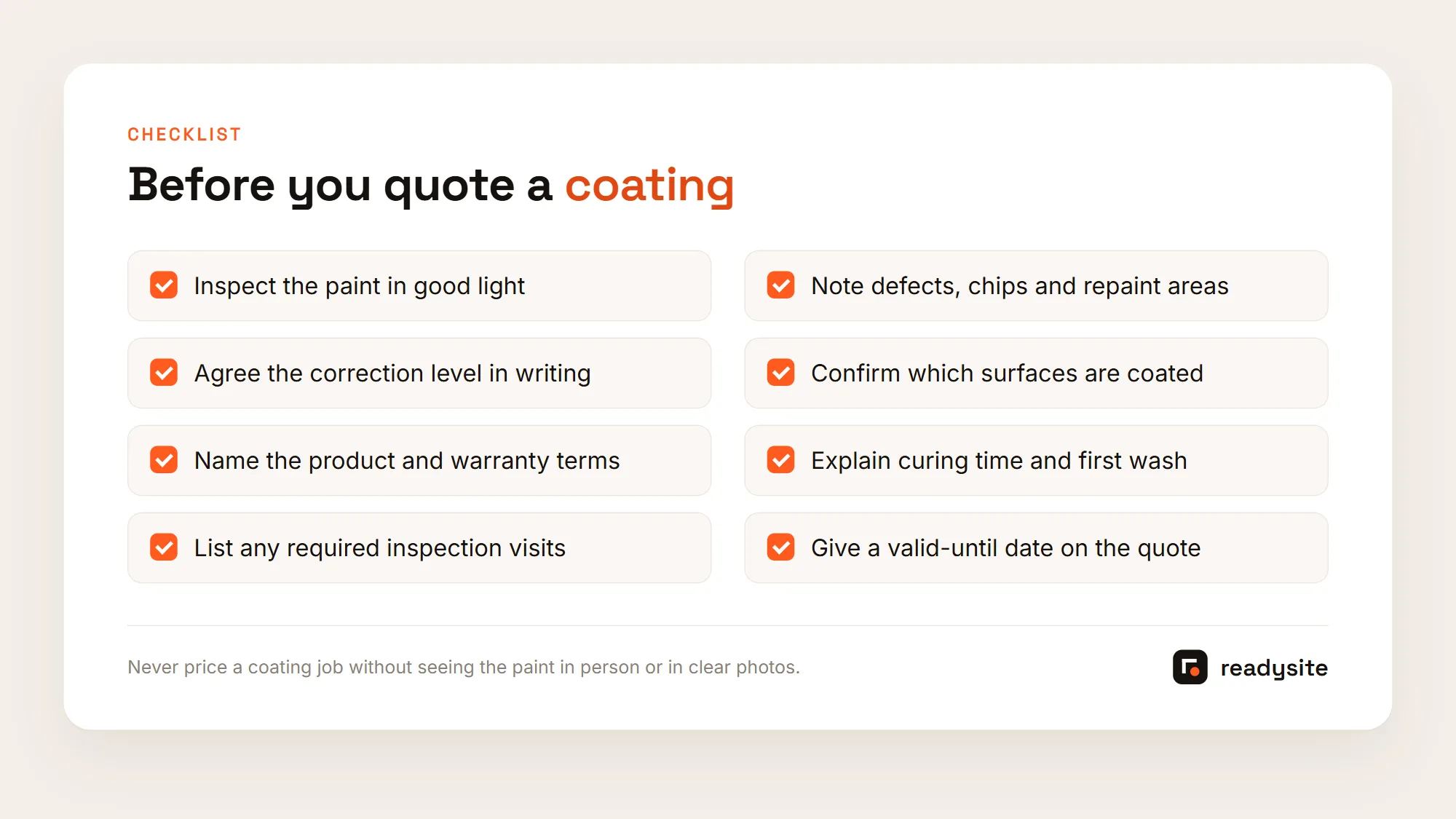
Inspect the paint in good light before you quote, and do a test spot before you commit to the full process. If the test spot shows the paint needs more work than expected, tell the customer and agree the change before you continue. Never promise that every scratch will disappear. Paint correction removes a thin layer of clear coat, so the goal is the best safe result, not perfection. Some deep scratches can’t be safely removed at all, and it’s better to say so up front.
Price Paint Correction On Its Own
Some customers want paint correction without a coating, and some want a ceramic coating on paint that needs far more work than any tier includes. Keep a separate hourly or per-step price for correction, built from the same rate and supplies lines, so you can quote it alone or add it on top of a tier. That keeps your ceramic coating pricing honest: the tier covers what it says, and extra work is priced in the open.
Write the paint correction level and the condition notes into every quote. Our detailing quote template has fields for both, which makes it much easier to point back to what was agreed if the customer later asks why the price changed.
How To Handle Warranty, Maintenance And Safety
Warranty is where coating prices differ most from other detailing work. A longer warranty usually means a pricier product, more layers or more prep, and often a commitment to inspection or maintenance visits. Each of those costs you something, so each should show up in the price, along with the safety gear the products call for.
Know Whose Warranty It Is
There are two kinds of promise. A manufacturer-backed warranty comes from some professional coating brands through certified installers, often with registration steps and conditions such as periodic inspections. Read the brand’s terms closely and explain them to the customer in plain words. Your own workmanship guarantee is different: it’s a promise about your work, such as fixing high spots or missed areas within a set number of days. Be clear in writing about which one the customer is getting, because they’re easy to confuse.
Written Warranty Rules And Durability Claims
The FTC’s Businessperson’s Guide to Federal Warranty Law explains that the federal law covers written warranties on consumer products, does not apply to warranties on services, and does not require a written warranty at all. Whether it reaches a coating warranty depends on how it’s structured, so this isn’t legal advice; ask an attorney to review your wording once. Be careful with “permanent,” “lifetime” or “scratch-proof.” The FTC’s Advertising FAQs for small business say advertisers need proof before an ad runs.
Build Maintenance And Aftercare Into The Price
Coatings need proper washing to perform well, and many warranties depend on it. You can include a first maintenance wash or inspection in the price, or sell a maintenance plan separately; our guide to detailing membership plans covers how to price and bill those. If the warranty requires inspections, decide who pays and say so in the quote. Give every customer written aftercare instructions: how long to wait before the first wash, what products to avoid and what voids the warranty. Clear aftercare means fewer claims.
Safety Data Sheets And Protective Gear
Coatings and prep chemicals come with safety data sheets. If you have employees, OSHA’s hazard communication page explains that employers with hazardous chemicals must have labels and safety data sheets for exposed workers and train them to handle the chemicals appropriately. Build gloves, ventilation and any respirators the sheets call for into your supplies line. Even as a solo detailer, reading the sheets for every product you use is a sensible habit that protects your health.
None of these costs are dramatic on their own, but together they’re often the difference between a ceramic coating job that pays and one that quietly loses money over the warranty period. Put each one into the worksheet rather than hoping it averages out.
How To Build And Present Ceramic Coating Pricing Tiers
Once the worksheet is filled in, turn the numbers into a short menu customers can understand. Three tiers is a common choice, because it gives people a clear middle option without overwhelming them. The example below shows the method; your own numbers will be different.
An Illustrative Three-Tier Example
Worked example (illustrative), mid-size sedan, middle tier: prep 4 hours, one-step enhancement polish 3 hours and coating application 2 hours make 9 hours at $60 an hour, or $540. Product $60 and supplies $20 add $80. Warranty reserve $40, overhead share $80 and margin $160 bring the total to $900. On the same illustrative menu, an Essential tier with prep only and a shorter-durability coating on paint might be $600. An Elite tier with multi-step correction, coated glass, wheels and trim, and the longest warranty might be $1,600.

Laid out as a menu, the same illustrative example looks like this.
| Tier | What it includes | Illustrative price |
|---|---|---|
| Essential | Prep only and a shorter-durability coating on paint | $600 |
| Middle tier | Prep, one-step enhancement polish and coating (9 hours at $60, $80 product and supplies, $40 warranty reserve, $80 overhead, $160 margin) | $900 |
| Elite | Multi-step correction, coated glass, wheels and trim, longest warranty | $1,600 |
These hours and prices are invented to show the method, not market prices or recommendations. The jump from the middle tier to Elite is large because multi-step correction adds many hours, the longer warranty needs a bigger reserve, and more surfaces use more product.
Size Adjustments And Jobs To Turn Down
Add size adjustments for SUVs, trucks and vans based on the extra hours and product you measure. Many owners show “starting at” prices for a sedan in good condition and quote everything else after inspection. Not every car is a good candidate. Failing clear coat, heavy repaint areas, or a customer expecting a ceramic coating to hide deep scratches are all reasons to pause. Suggest paint correction or a simpler sealant where it fits, and walk away when expectations can’t be met.
Present Prices Customers Can Compare
Customers shopping for coatings compare quotes, so make yours easy to compare and easy to trust. Show a starting price per tier and what it’s based on, name the correction level in plain words, list the surfaces coated, and state the warranty length, who backs it and what it requires. Explain curing time and when the car can be washed, and say that the final price follows an inspection. On your website, list coatings as separate services, as our detailing service menu guide explains.
Review Your Prices After Every Few Jobs
Ceramic coating pricing isn’t a one-time decision. After every few jobs, compare the hours you quoted with the hours you spent, and the product you planned with the product you used. If prep keeps running over, raise the prep hours or tighten your inspection. If paint correction varies widely, add more defined levels. If warranty visits eat time, increase the reserve on longer tiers. If product costs rise, update the supplies line that day. Small, frequent changes are easier on customers than one big jump.
A clear menu also needs somewhere to live. You can build your detailing website free with ReadySite and add your tiers, before and after photos and a quote form that asks for vehicle details and photos, so every enquiry arrives with what you need to price it.

Conclusion
Good ceramic coating pricing comes from your own numbers: the hours you spend on prep, paint correction and application, the product you really use, a warranty reserve, overhead and margin. Group those results into a few clear tiers, name the correction level in writing, and review the numbers after every few jobs. On your next ceramic coating job, time every step and record the product you use. That one exercise will teach you more than any competitor’s price list.
Want a site that presents your coating tiers clearly without building it yourself? ReadySite’s done-for-you plan is $299 one time for up to five pages, with the wording written for you and a free preview before you pay anything. If you’d rather do it yourself, the free plan costs $0 and you can upgrade later.
Done-for-you websites
Want your website built for you?
ReadySite writes the wording, builds up to 5 pages and sets up your Google Business Profile. $299 one time, and you see a free preview before you pay.