Website Builder vs Web Designer: Which Is Right for Your Local Business?
Build it yourself or hire someone? A plain comparison of cost, time, control and risk for local service businesses, with a 6-question decision score.


In the website builder vs web designer choice, most local service businesses are better off starting with a website builder and hiring a web designer only when they need something a builder can’t do well. A builder is cheaper, faster and puts you in control of every change. A good web designer brings custom design, strategy and writing, but costs more, takes longer and usually means waiting for changes.
There’s also a third option many owners miss: a done-for-you service that builds the site for a fixed fee, often faster and cheaper than a custom designer. This guide compares all three on cost, time, control and risk, gives you a six-question decision score, and covers the questions to ask before you pay anyone. We make a website builder (ReadySite) and also offer a done-for-you service, so we’ll say plainly when a web designer is the better choice.
What The Website Builder vs Web Designer Choice Means
When owners say “website builder vs web designer,” they usually picture two choices. In practice there are three ways to get a website for a local business, and each asks something different of you. None is right for everyone. A one-van detailer, a three-person plumbing company and a regional roofing business with a sales team need different things, so start by understanding what each route really involves.
A DIY Website Builder
You sign up, pick a design or answer a few questions, add your details and publish. You do the work, and you keep full control from the first day. The best builders for local businesses are made for exactly this: a clear site with your services, prices, area, reviews and contact buttons, live in an afternoon. The trade-off is your own time. Nobody writes the words for you, and nobody reminds you to update your prices when they change.
A Web Designer Or Agency
You hire a person or studio to plan, design and build a site for you. It’s usually priced per project, sometimes with a monthly fee for hosting and changes afterward. A good web designer can give you a look nobody else has, plan the pages around how your customers search, and write persuasive copy. You still supply information and review drafts, and the project normally runs for weeks rather than days.
A Done-For-You Service
A company builds a site for you from a short brief, for a fixed price, using a proven layout. It’s less custom than hiring a designer, and much less work than doing it yourself. For many owners it lands in the middle on every measure: cost, time and flexibility. Some done-for-you services, including ours, let you see a preview before you pay, and then hand you an editor so you can make small changes later without waiting on anyone.

Done-for-you websites
Want your website built for you?
ReadySite writes the wording, builds up to 5 pages and sets up your Google Business Profile. $299 one time, and you see a free preview before you pay.
How Do Cost, Time And Control Differ?
Most of the website builder vs web designer decision comes down to three things: what you pay, how long it takes and who controls the site afterward. It’s easy to compare the wrong numbers, so look at the full picture for each, not just the headline price.
What You Actually Pay
Many builders have a free plan and a paid plan for your own domain. At the time of writing, ReadySite’s free plan is $0 and Pro is $9 a month to connect your own domain, which you buy separately, and other popular builders range from a few dollars to around $18 a month for entry plans. The hidden cost is your time for setup, writing and updates. Our free vs paid website builder guide includes a three-year cost worksheet.
A web designer prices per project, and quotes vary widely with experience, location and scope. A simple freelance site and a custom agency site can differ by thousands of dollars. Ask for an itemized quote and add hosting, domain and the price of changes. Done-for-you services charge a fixed fee: ReadySite’s is $299 one time for up to five pages with the wording written for you.
Here is what each route costs in cash, using the figures in this section.
| Route | What you pay |
|---|---|
| ReadySite Free | $0 |
| ReadySite Pro (own domain) | $9 a month |
| Other popular builders, entry plans | A few dollars to around $18 a month |
| Done for you (ReadySite) | $299 one time for up to five pages |
Time To Go Live And Time From You
A website builder can have you live the same day. A web designer project usually takes weeks, because of meetings, drafts and rounds of feedback. Done for you typically takes days. The time asked of you differs too. With a builder, you do the work. With a designer, you still supply information, review drafts and often write or approve the text. Done for you asks for a short brief and a review. For a busy owner, time is often the deciding factor, more than money.
Making Changes And Holding The Keys
With a website builder you can change a price in a minute. With many designers you email a request and wait, sometimes paying per change, so ask before you hire. If you change prices, services or seasonal offers often, editing the site yourself is worth a lot. If your site rarely changes, waiting matters less. Control matters either way. Builders give you the keys from day one. With a web designer, make sure the domain, hosting login and site files are in your name, so you’re never stuck.
What We Found When We Timed A Real Build
We tested this ourselves on October 28, 2026. On a phone-sized screen we typed a business name and one sentence into ReadySite’s two-question form and pressed Create my website, three times for three kinds of business: a mobile detailer, a plumber and a hair salon. Each finished one-page site appeared 22 to 27 seconds after the button press, with the wording written, photos chosen and the phone number placed. The tests ran on our local copy of the site, so timing on the live service can differ a little.

Don’t compare a designer’s project price with a builder’s monthly fee on its own. Add each option up over three years, including hosting, changes and your own hours, and the real gap between them becomes much clearer. Seen that way, website builder vs web designer is less a question of cheap against expensive and more a question of where you want to spend: your money, or your evenings.
When Each Option Is The Better Choice
Neither option wins every time. A website builder suits most small local businesses, but there are clear cases where a web designer earns the fee, and plenty where a done-for-you build is the sensible middle. These descriptions should help you see which group you’re in.
When A Web Designer Earns The Fee
Hire a web designer when you need things a builder does poorly. That might be a distinctive brand that doesn’t resemble any template, for a premium or design-led business. It might be complex features such as custom booking logic, links to your job management software, customer portals or several locations. It might be dozens of service and location pages planned around a search strategy, or someone to research your market and write persuasive copy. If several of these apply, and you have the budget, a good designer is worth it.
When A Website Builder Is The Smarter Start
A website builder fits when you need a clear site with your services, prices, area, reviews and contact buttons rather than a bespoke design. It also fits when you want to be online this week, change prices or photos often, have a small budget, or aren’t sure yet what the business will look like in a year. A builder made for local businesses removes much of the setup work. ReadySite, for example, builds the site from your answers about your trade, services and area, with call, WhatsApp and quote buttons included.
If you’re comparing builders, our guide to the best free website builder for local businesses scores the main options side by side. When you compare, look past the template gallery. Check that the builder makes it easy to add tap-to-call and a quote form, that pages look good on a phone without extra work, and that you can connect your own domain when you’re ready. Those details matter more to a local customer than fancy animation.
Three Businesses, Three Answers
These are illustrative examples. A new solo locksmith has a small budget and busy evenings but is happy to write a few lines. He needs his number, services, prices and area online this week, so a website builder on a free plan fits, moving to his own domain when work is steady. An established cleaning company with six staff has steady work and no time, and wants a page for each service. Done for you fits, with small edits later. A roofing company covering three counties needs dozens of pages, software integration and a distinctive brand, so a web designer with a clear written scope is the right call.
Notice that budget alone didn’t decide any of these. Time, the number of pages and how often the site changes mattered just as much. That’s the real lesson of the website builder vs web designer debate: the right answer depends on the business in front of you, not on which option sounds more professional. A plain site that is live, accurate and easy to call from beats a beautiful one that is still in draft.
How To Decide Website Builder vs Web Designer
If you’re still unsure, a short score and an hour of preparation will usually settle the website builder vs web designer question. Both also make whichever route you choose faster and cheaper, because the most important work on any website is gathering your own information.
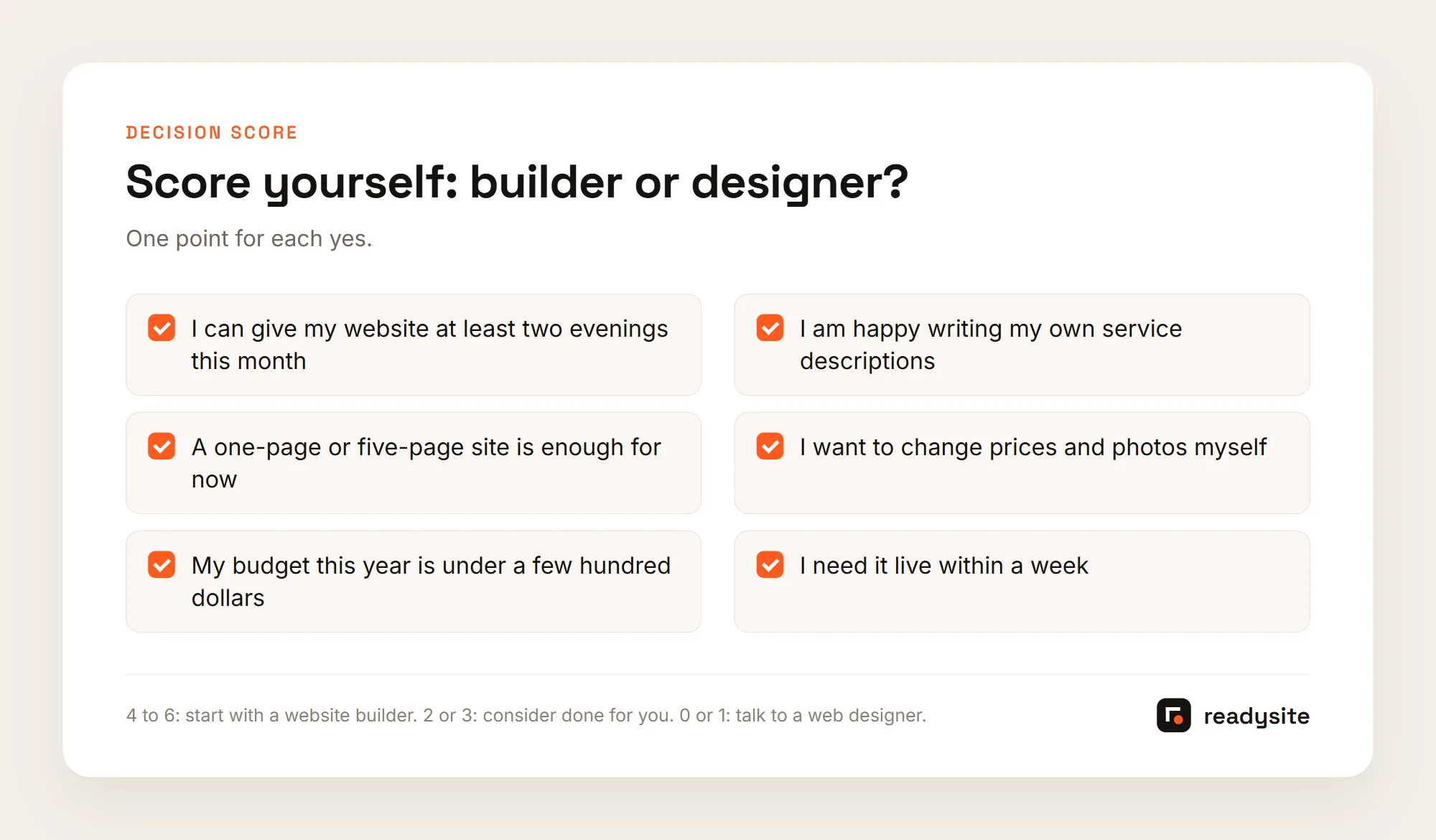
Take The Six-Question Score
Answer the six questions in the score honestly, then count your yes answers. Your available time matters as much as your budget, so don’t answer for the week you wish you had. With 4 to 6 yes answers, start with a website builder, because you have the time and your needs match. With 2 or 3, a done-for-you service is likely the best fit, giving you a finished site without a designer’s price or timeline. With 0 or 1, talk to a web designer, since your needs or your lack of time point to hiring help.
Example: A Two-Truck Landscaping Company
This is an illustrative example. The owner can spare one evening, doesn’t enjoy writing, needs five pages and wants to change seasonal offers himself. His score is 3. A done-for-you build with an editor he can use for small changes fits better than either doing it all himself or paying for a full custom project. He gets a finished site quickly, keeps control of his seasonal offers and doesn’t pay for design work he doesn’t need.
Prepare Your Content Before You Choose
Whichever way you go, the work that matters most is yours. Write down your services in the words customers use, with a starting price where you can. Add the towns or ZIP codes you cover, your hours, three to five genuine reviews you already have, real photos of you, your team and your work, your contact details and one goal, usually “call us” or “request a quote.” If you can write all of it in an hour, a website builder will likely suit you. If it feels like a chore you’ll never finish, pay for help with the writing.
Know How Each Option Handles Google
Owners often assume a web designer will get them found on Google and a builder won’t. In reality, the basics of local visibility are the same on any platform, and none can promise rankings. Clear wording with your service and town, a fast mobile-friendly site, a complete Google Business Profile that links to your site, and steady genuine reviews matter most. Never pay for reviews or ask only happy customers. A designer adds value mainly on a larger site planned around many services and locations.
Once you have a score and your content, the decision is usually obvious. If it isn’t, starting small is the safer bet, because you can always hire a designer later with better information.
Mistakes To Avoid When You Hire Or Build
Most website problems for small businesses aren’t about design. They come from unclear agreements, lost logins, empty promises and sites nobody keeps up to date. Avoid these mistakes and either route can serve you well for years.
Hiring Without Answers In Writing
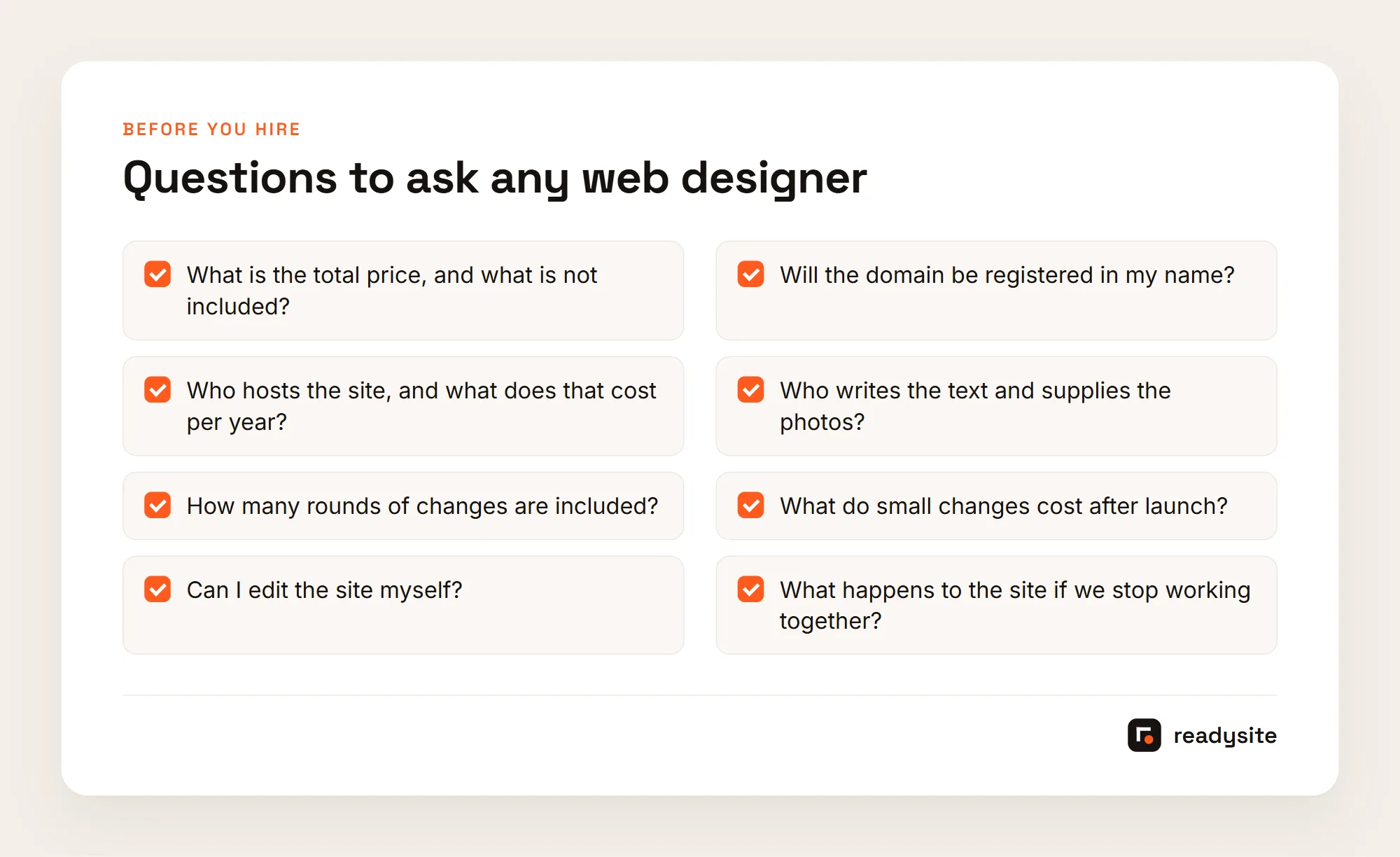
If you decide to hire, the questions you ask up front prevent most problems later. Ask every web designer the same questions: what’s included, how many rounds of changes, what happens after launch, who owns the files and logins, and what each later change costs. Get the answers in writing before you pay a deposit. A good designer will be glad to answer, and comparing written answers side by side makes the right choice much easier.
It also helps to ask who will write the words on each page, how the designer tests the site on phones, and what you’ll need to supply and by when. A project that stalls for weeks waiting on your photos or service list costs you time with nothing to show for it. Agree on a simple timeline with dates for the first draft, your feedback and launch, so both sides know what to expect.
Letting Someone Else Own Your Domain
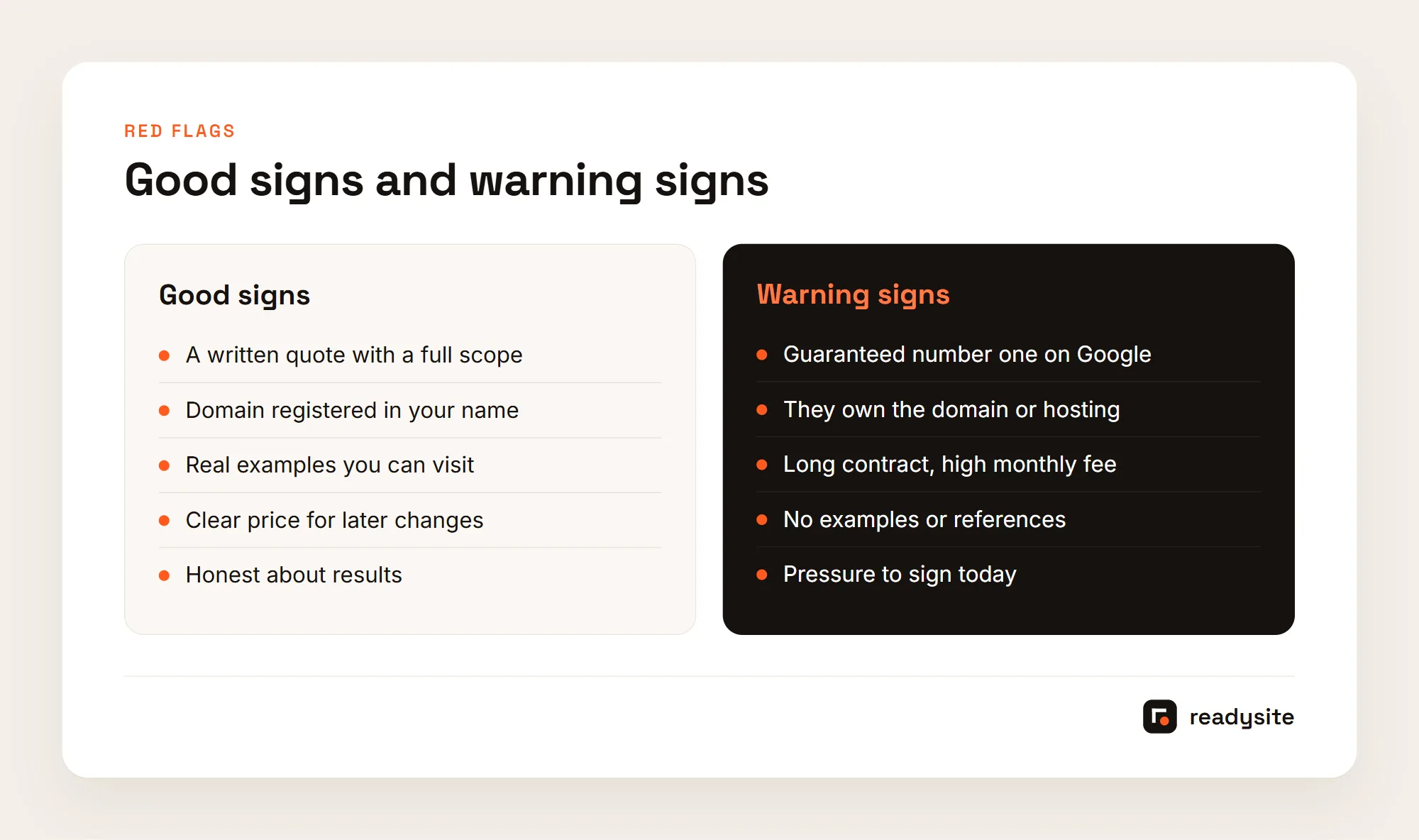
Your domain is the one part of your website you should always control. It should be registered in your name, with you as the registrant. ICANN explains that the registrant (the registered name holder) is the one with rights to renew and transfer the domain. If a designer registers it for you, make sure your name is on it and that you keep the login. That way, moving to a new web designer or website builder later is simple.
Trusting Ranking Promises And Skipping Security
Be careful with anyone who promises search rankings. Google’s own guide, Do you need an SEO?, states that no one can guarantee a number one ranking and warns about unsolicited offers. Ask about security basics too. The FTC advises small businesses to look for hosting with TLS (https) and email authentication. Any one warning sign is a reason to slow down and ask more questions.
Choosing On Price Alone And Forgetting Upkeep
The cheapest option that takes all your evenings, or never gets finished, isn’t cheap. Avoid long contracts until you know what works, and always check the finished site on your phone, where most local customers see it first. Then plan upkeep. Each month, tap your own call button and send a test quote request. Each season, update prices, offers and hours, and add recent photos. Once a year, check your domain renewal date. If you can’t see yourself doing this, choose a route where someone else can.
A little care at the start saves a lot of frustration later. Whichever route you choose, keep control of your domain and logins, get promises in writing and give the site a few minutes of attention every month.
Conclusion
The website builder vs web designer decision comes down to your time, your needs and your budget. For most small local businesses, a website builder is the right place to start. A done-for-you service makes sense when you’d rather not write or build it yourself, and a web designer earns the fee when you need a distinctive brand, complex features or many pages. Whichever you choose, prepare your content first and keep your domain in your name.
If your score pointed to doing it yourself, build your website free with ReadySite and see it with your own services in a few minutes. If it pointed to the middle option, request a free preview of a done-for-you site and decide after you see it. If you need a fully custom site, use the questions above to hire a designer with confidence.
Done-for-you websites
Want your website built for you?
ReadySite writes the wording, builds up to 5 pages and sets up your Google Business Profile. $299 one time, and you see a free preview before you pay.