Mobile Detailing vs Shop: A Decision Matrix and Scoring Worksheet
Compare mobile and shop-based detailing across six factors, then use a weighted scoring worksheet to decide which fits your stage, budget and services.


Mobile detailing vs shop comes down to a trade-off: mobile work costs less to start and goes where the customers are, while a detailing shop costs more but gives you weather protection, controlled conditions and more cars per day. For most new owners with limited cash, mobile is the lower-risk way to start. A shop tends to make sense once you have steady demand, services that need controlled conditions, and the numbers to cover rent every month.
This guide compares the two models across six factors that actually decide the outcome: costs, weather, capacity, pricing, regulations and growth. Then you get a simple scoring method so you can weigh those factors for your own situation, plus a lease checklist and the way each model changes your marketing.
If you don’t have a site yet, make your car detailing website free: type your business name and services, and ReadySite writes the page for you.
What Mobile Detailing Vs Shop Really Means
Neither model is “better.” Each one suits a different stage, budget and service menu. The useful question isn’t which one other detailers prefer, but which one fits the work you sell, the place you live and the money you have right now. The mobile detailing vs shop question also changes as your business grows, so treat your answer as a plan for the next year or two, not forever.
Two Models, Two Sets Of Trade-Offs
Read any comparison as a set of trade-offs rather than a scorecard. A strength on one side is usually a cost on the other. The shop’s controlled environment comes with rent, and the low overhead of a mobile setup comes with weather days and drive time. A mobile setup’s big decisions are the vehicle, water and power. A detailing shop adds rent or a mortgage, a deposit, utilities, build-out and property insurance, all before the first customer walks in.

Which Model Suits A New Owner
Many owners start mobile because it needs less money and lets them test demand before they commit to a space. A detailing shop makes more sense once you have steady bookings, services such as paint correction or coatings that need controlled conditions, and the cash flow to cover rent through slow months.
Is mobile more profitable? Not automatically. Mobile has lower overhead, while a shop can handle more cars and higher-value work. Profit depends on your prices, volume, costs and how full your schedule is, so run the numbers for your area with real quotes rather than going by what worked for someone else. If you’re still at the starting line, our guide on how to start a mobile detailing business covers the launch steps for the lower-cost route.
The Hybrid Middle Ground
You don’t have to choose all or nothing. Some owners stay mobile for routine work and rent bay time, share a space with another automotive business, or sublet part of a garage for coatings and correction. Others open a small shop and keep one van for customers who value convenience. If you consider sharing or subletting, check the lease terms, zoning, insurance and who is responsible for wastewater and damage, and get every agreement in writing.
A hybrid can be a useful test. Renting bay time one or two days a week shows you whether coatings and correction really book well before you take on a detailing shop of your own. If the bay sits empty, you’ve learned that cheaply. If it fills up, you have real numbers to bring to a landlord, and you keep your mobile setup running the whole time.
Done-for-you websites
Want your website built for you?
ReadySite writes the wording, builds up to 5 pages and sets up your Google Business Profile. $299 one time, and you see a free preview before you pay.
Which Is Better For You, Mobile Detailing Vs Shop?
Four of the six factors are about money and time: what it costs to start, what it costs each month, how many days weather takes from you, and how many cars you can finish. These are the ones most owners underestimate, so work through them with real numbers for your area.
Startup Costs
Cost is where the two models differ most. Many mobile owners start with a vehicle they already own and a lean kit, then add a tank and generator as demand grows. A detailing shop typically needs a lease deposit, build-out such as drainage, lighting and power outlets, equipment that suits a fixed bay, and permits for the space. For line-by-line budgeting of the mobile side, see our guide to car detailing startup costs.
Monthly Costs And Break-Even
Monthly costs matter even more, because they set the minimum number of jobs you need. A mobile detailer’s big monthly costs are usually fuel, vehicle wear, insurance and products. A shop adds rent and utilities, paid whether customers show up or not. The SBA’s guide to picking a business location lists rent, insurance rates, utilities and local fees among the costs that vary by location, so price a specific space, not an average.
Example (illustrative): if a shop adds $2,000 a month in rent and utilities, and your average job leaves $100 after product costs, you need 20 extra jobs a month just to cover the space. If the shop lets you do 25 more jobs a month than you could mobile, it pays. If it only adds 10, it doesn’t. Replace these numbers with real quotes for your area.
Weather And Working Conditions
Weather is the factor mobile owners feel most. Rain, heat, cold, wind and direct sun all affect what you can do outdoors and how good the results are. Polishing and coatings need controlled temperature, light and dust levels a driveway can’t always provide. A detailing shop removes most of that. Mobile owners reduce the problem with canopies, booking buffers, rescheduling policies and customers’ garages where allowed, but never remove it. If your area has long rainy seasons or very hot summers, count the working days you’d realistically lose.
Then put a number on it. Multiply the days you’d lose in a typical year by what an average working day earns you, and compare that with the yearly cost of a space. For some owners in mild climates the loss is small. For others it’s the strongest argument for a shop or at least a covered place to work.
Capacity And Cars Per Day
Capacity is where a shop often wins once demand is there. Without drive time between jobs, you can schedule back to back, work on two cars at once with a helper, and keep cars overnight for multi-day correction or coating work. A mobile setup’s capacity is limited by travel and setup, because every job includes driving, unloading, setting up water and power, and packing up. A tight service area and grouped bookings at one office park or apartment complex help a lot.
Look at which part of each job takes longest, and whether a tool upgrade such as an extractor or a hose reel would cut it. Small changes can add a job or two per week to a mobile setup without the rent of a detailing shop.
Put those four together and the money picture usually becomes clear. Low startup cost and fewer fixed bills favor mobile. Weather protection and higher daily capacity favor a shop, but only if you have the demand to fill it.
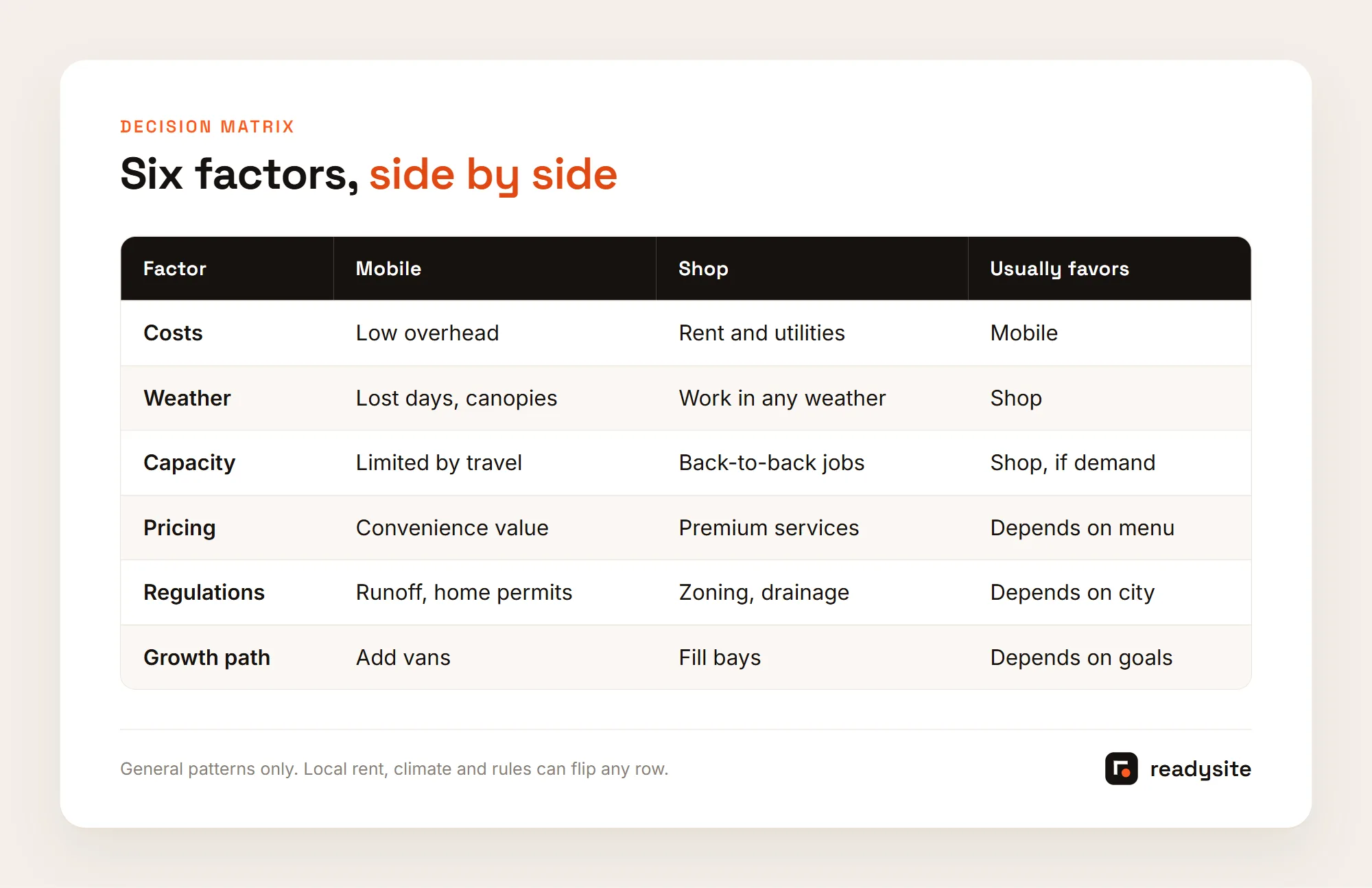
Pricing, Rules And Growth For Each Model
The last three factors are less about this month’s numbers and more about the business you’re building: what customers will pay for, which rules apply where you work, and how each model grows over the next few years. Requirements vary by state, county and city, so check locally. This is not legal advice.
Pricing And The Convenience Factor
Mobile detailing sells convenience. Customers don’t have to drop off their car, arrange a ride or wait, and many mobile owners build that into their prices or charge travel fees for longer distances. A detailing shop sells controlled conditions, specialist equipment and often a more premium image, which suits correction, coatings and multi-day work. So the question isn’t which model charges more. It’s which fits the services your customers want. See our detailing service menu and car detailing prices guides.
Rules For A Mobile Setup
Mobile detailers typically need a business license, may need a home occupation permit if they run the business from home, and must follow local rules about wash water. The EPA’s stormwater fact sheet on vehicle washing explains that storm drains lead to waterways rather than treatment plants. That’s why many cities restrict runoff from mobile washing, and some require water capture. Ask your city or county stormwater office what applies before you buy water equipment for your mobile setup.
Zoning And Insurance For A Detailing Shop
A fixed location must be zoned for the use and may need suitable drainage. The same EPA fact sheet notes that commercial washing facilities often recycle water or treat it before it goes to the sanitary sewer. The SBA’s page on licenses and permits recommends checking zoning with your planning department before you commit. The NAIC’s small business insurance guide notes that landlords usually insure only the structure, so you’d need your own cover. Our detailing business insurance guide covers both models.
How Each Model Grows
Mobile businesses usually grow by adding vans and technicians, tightening the service area, and adding recurring work such as maintenance plans or fleet accounts. Growth is gradual, and each new vehicle is a manageable step. A detailing shop grows by filling bays, adding staff and raising average job value through specialist services. The jump from mobile to shop is a big step, but once a shop is full, it can handle work that’s hard to do in a driveway.
Many owners do both over time. They start mobile, build a customer base and reviews, then open or share a shop when demand and cash flow support it, keeping a van for convenience jobs. The mobile detailing vs shop decision isn’t permanent, and it’s worth revisiting as the business changes.
How To Score Your Own Mobile Detailing Vs Shop Decision
A scoring worksheet turns a fuzzy decision into numbers you can compare. It won’t make the decision for you, but it shows which factors matter most to you and where each model wins. Start with a reality check on capacity, then score, then sense-check the result.
Run A Quick Capacity Check
Write down the jobs you did, or could book, last month, the average hours per job, and the average drive and setup time. Then estimate how many more jobs per week a fixed bay would allow. If the answer is “not many, because I don’t have the demand,” the shop’s extra capacity has no value yet. Before deciding a shop is the only way to grow, group bookings by area on set days, offer multi-car discounts at one address and prepare towels and bottles the night before.
Weight And Score Six Factors
Weight each of the six factors from 1 to 3 by how much it matters to you. If cash is tight, cost gets a 3. If you live somewhere with long rainy seasons, weather gets a 3. Then score each model from 1 to 5 on each factor for your situation, using real quotes and your own numbers. Multiply each score by its weight, and add up the totals for mobile and for shop. The whole exercise fits on one sheet of paper and takes about half an hour.
Read The Result Honestly
If the total surprises you, look at which factor drove it and whether your scores are realistic. In the illustrative worksheet, the mobile setup wins mainly on cost, with smaller edges on pricing and regulations, while the detailing shop wins on weather, capacity and growth. If that owner’s demand doubled and weather cost them many working days, the scores would shift, and a shop or hybrid would deserve a closer look. Many rows honestly say “depends,” because local rent, climate and competition change the answer.

Check The Lease Before You Sign
If the numbers point toward a shop, slow down at the lease. A detailing shop lease is usually a multi-year commitment. Confirm with the planning department that detailing is allowed at that address. Ask about drains and what the sewer authority requires for wash water. Check power for polishers, vacuums and lights running at once, plus lighting, ventilation, parking and drop-off space. Read who pays for repairs, build-out, signage, taxes and insurance, and what happens if you need to leave early.
Have an attorney review the lease, and ask your insurance agent what a shop at that address would need before you commit. Those two calls cost little compared with being locked into the wrong space for years. Keep your worksheet, too. Scoring the mobile detailing vs shop question this way gives you a record to compare against in six months.
Marketing A Mobile Setup Or A Detailing Shop
Customers ask different questions depending on whether you come to them or they come to you. Your website, Google profile and messages need to answer different things for each model, and a hybrid has to answer both without confusing anyone.
Marketing A Mobile Setup
Mobile customers want to know whether you serve their area, what you need from them, such as water, power and parking space, how long you’ll be there and your arrival window. List your towns or ZIP codes, explain your mobile setup in one or two sentences, and show photos of real jobs in real driveways. Rescheduling rules for weather belong on your booking page too, so nobody is surprised when rain moves their appointment.
Marketing A Detailing Shop
Shop customers want your address, opening hours, drop-off and pick-up process, how long you keep the car and whether you can arrange a ride. Photos of the space itself, such as clean bays, good lighting and a waiting area, build trust. Specialist services such as coatings and correction deserve their own pages, because those buyers research carefully. Google treats the two models differently too, and our guide to Google Business Profile for detailers covers the setup for each.
Explaining A Hybrid Clearly
If you run both, say so in one plain sentence near the top of your site: “We come to you for washes and interiors. Coatings and correction are done at our shop.” That single line prevents a lot of confused calls. Then make sure the rest of the site follows the same split, with your service area listed for mobile work and your address and hours listed for shop work, so customers know exactly what to expect for each service.
Whichever model you choose, customers still need to find you and understand how you work. You can build a free detailing website with ReadySite that shows your services, service area or location, photos and tap-to-call, all on one clear page.

Conclusion
The mobile detailing vs shop choice is easier, and safer, when it’s based on your numbers rather than someone else’s setup. Compare costs, weather, capacity, pricing, rules and growth, then fill in the scoring worksheet with your own weights tonight. If mobile wins, start lean and revisit the decision every six months. If the detailing shop wins, get zoning answers and real quotes before you sign anything, and keep a hybrid in mind as a middle step.
Want a site that explains how you work, mobile, shop or both? Request a free preview of a done-for-you site. ReadySite writes the wording for up to 5 pages, and you only pay if you like it.
Done-for-you websites
Want your website built for you?
ReadySite writes the wording, builds up to 5 pages and sets up your Google Business Profile. $299 one time, and you see a free preview before you pay.