Fleet Detailing Contracts: How to Find, Price and Keep Commercial Accounts
A practical playbook for fleet detailing contracts: where to find commercial accounts, a scoping checklist, a per-vehicle pricing worksheet, agreement terms and wash water basics.


Fleet detailing contracts are recurring agreements to wash or detail a business’s vehicles on a set schedule at an agreed price per vehicle. To win them, you find businesses that run vans, trucks or cars with their name on the side, walk their lot before you quote, price each vehicle class from your own timed work, and put the scope, payment terms and wash water handling in a short written agreement.
Fleet work is not for every detailer. It pays less per vehicle than retail, often pays 30 days later, and usually happens at dawn or after hours. In return you get predictable volume, fewer one-off sales calls, and a base of work that keeps your calendar steady in slow months. This guide covers where commercial accounts come from, how to scope and price them, what the agreement should say, how to get paid and the stormwater rules that matter far more for fleet washing than for a driveway detail.
No website yet? Our car detailing website builder makes one from two answers, free, with call, text and quote buttons ready for phone visitors.
What Fleet Detailing Contracts Involve
“Fleet” covers a wide range of customers. A plumbing company with eight branded vans, a car dealer that needs used cars prepped for the lot, a property manager with a few maintenance trucks and a city department with dozens of pickups are all fleet customers. Their needs, budgets and paperwork are very different, so it helps to know what fleet detailing contracts usually cover before you sign one.
The Three Service Types
Most fleet detailing contracts fall into three service types. Exterior fleet washing happens on a schedule, often weekly or biweekly, so branded vehicles look professional on the road. Interior refreshes suit vehicles that carry passengers or that crews live in all day: vacuum, wipe down, trash out and glass. Turnover or reconditioning details happen when a vehicle changes driver, goes back to a lessor or is sold. Many customers mix all three, and your agreement should name each service, which vehicles get it and how often.
Common Types Of Commercial Accounts
Trades and home services, like plumbing, HVAC, electrical, pest control and cleaning companies, are the most common commercial accounts for a local detailer. Car dealers and independent used car lots without an in-house detail team are another good fit. So are property managers, HOAs and apartment communities with maintenance vehicles, plus delivery, courier, moving, limo and shuttle operators. Local government, school districts and utilities also buy fleet washing, usually through a formal bid with its own paperwork.
Is Fleet Work Right For Your Business
Fleet detailing contracts are built on reliability. A fleet customer expects you to show up every scheduled time, in any season, with the same quality on vehicle 40 as on vehicle 1. Before you chase one, ask yourself five questions. Can you pay for products, fuel and labor for a month before the first invoice is paid? Can you work early mornings, evenings or weekends? If an account needs 30 vehicles done in one morning, do you have the people and equipment? Can you capture wash water where required? Does your insurance cover work at a customer’s yard?
If a couple of answers are “not yet,” start with smaller accounts of five to ten vehicles. Our guide to detailing business insurance explains the coverage fleet customers usually ask about, and the mobile detailing equipment list covers what to add as volume grows.
Done-for-you websites
Want your website built for you?
ReadySite writes the wording, builds up to 5 pages and sets up your Google Business Profile. $299 one time, and you see a free preview before you pay.
Where To Find Commercial Accounts
Most fleet detailing contracts start with a conversation, not an ad. The good news is that fleets are easy to spot: they park in yards, drive past you every day and often have phone numbers painted on the side. Here’s where most commercial accounts actually come from.
Start With Vehicles You Already See
For one week, write down every branded van or truck you see in your service area: the company name, the number of vehicles if visible, and how clean they look. A dusty fleet with the owner’s logo on it is your warmest lead, because a dirty van is a moving advertisement for the wrong thing. Then search Google Maps for trades in your area, such as plumbers, HVAC companies, electricians and landscapers, and note which ones list several technicians or trucks.
Ask Retail Customers And Visit Dealers
Your existing customers own businesses, manage teams and know fleet managers. After a retail job, ask: “Do you know anyone who runs a few work vans or company cars?” One introduction to an owner beats ten cold emails to a generic inbox. Smaller dealers often need lot cars cleaned and sold cars prepped fast. Visit in person, ask for the used car manager, and offer to do one car so they can judge your work. Ask how they handle reconditioning now and what slows it down.
Look For Public Bids
Cities, counties, school districts and utilities buy vehicle washing through their purchasing departments. Search your city or county website for “purchasing,” “bids” or “vendor registration.” Public bids involve paperwork and fixed specs, and you’ll compete on price against other approved vendors. In return, the terms are written down in advance and payment is usually reliable once you’re approved. They’re worth watching even if you don’t bid right away, because they show you what larger buyers expect.
Send A Short First Message
Example script: “Hi Dan, I run a mobile detailing company here in [area]. I noticed your vans around town and wanted to ask: who looks after keeping them clean? I set up on site, before or after your crews head out, and charge a fixed price per vehicle. Would a 10-minute look at your yard next week be useful?” Keep it short, mention something specific about their business, and ask for a site visit, not a sale.
When a fleet manager looks you up, they’ll check whether you look established. A clear website with commercial services, your service area and a quote form does a lot of that work. You can build your car detailing website free with ReadySite and add a “Fleet and commercial” section next to your retail services.
How Do You Scope And Price Fleet Detailing Contracts?
The biggest pricing mistakes in fleet washing come from quoting by phone. A “quick wash for 12 vans” can mean clean vans in a paved yard with a hose bib, or mud-caked vans on gravel with no water and a storm drain in the middle of the lot. Always walk the site first, then build your price from what you saw.
Walk The Site Before You Quote
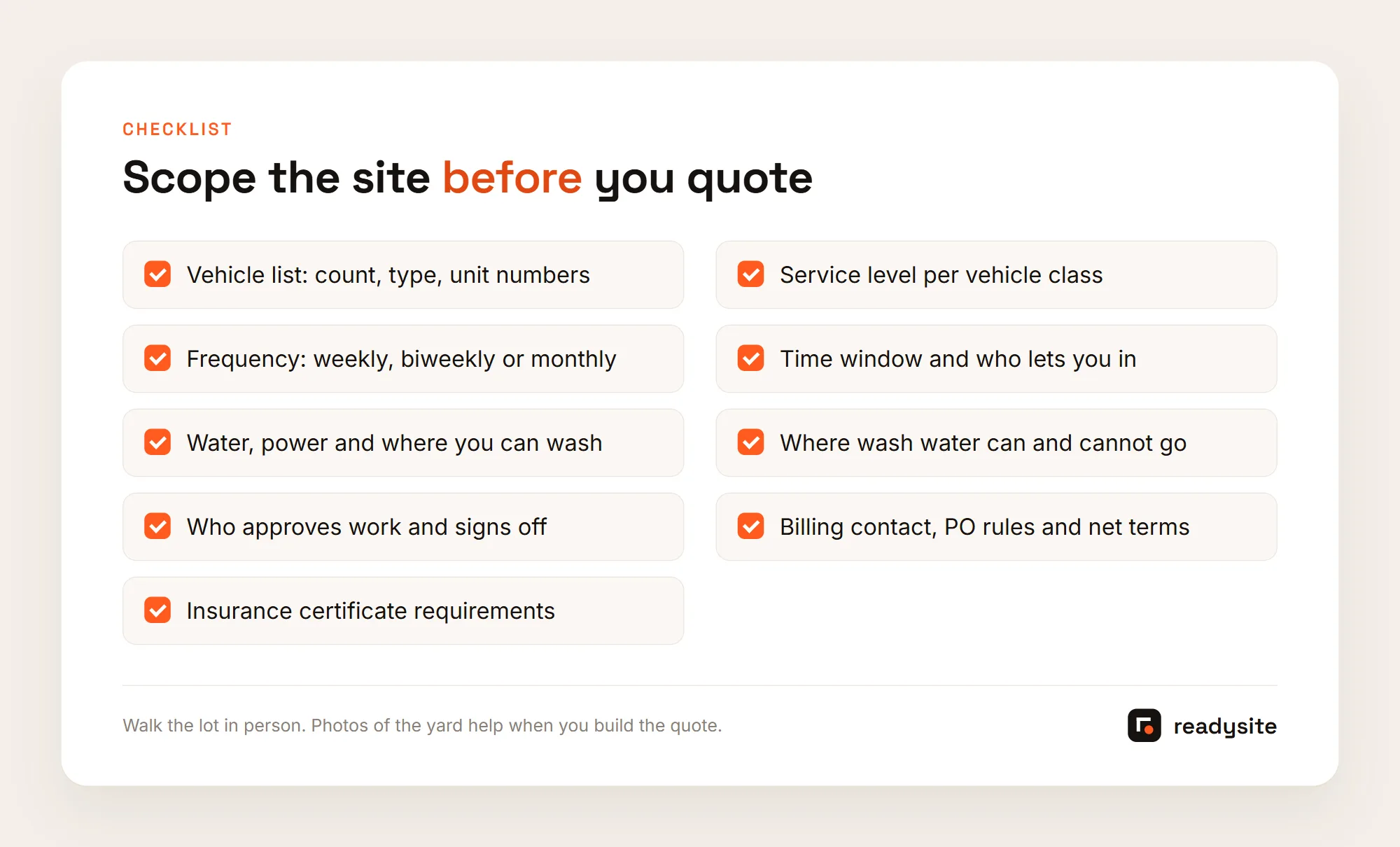
On the visit, confirm the vehicle list, the parking layout, water and power access, drainage, the time window and any insurance requirements. Time yourself on one or two typical vehicles if the customer allows it. That single number, minutes per vehicle, is the base of your quote. Note anything that slows you down: ladders for roof racks, tight parking rows, or vehicles that leave at different times. Also ask what’s going wrong today, so your proposal answers that specific problem.
Write down who the decision maker is. In a small company it’s the owner. In larger ones it may be a fleet manager or purchasing department, and each cares about different things: image, driver complaints or the lowest compliant price.
Build A Price Per Vehicle Class
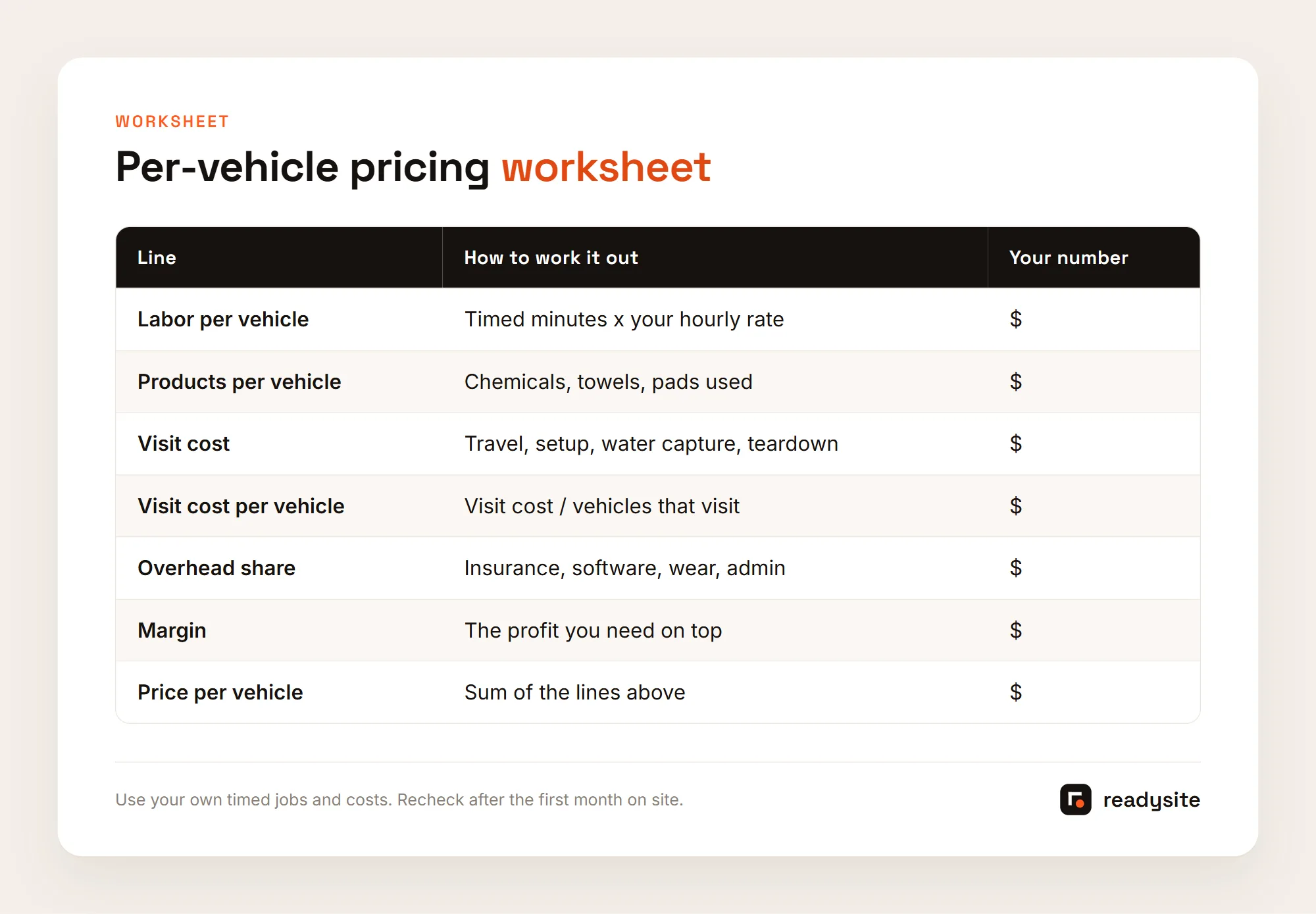
Commercial accounts think in price per vehicle per visit. Build that number from your own costs instead of copying a retail menu or guessing at competitors. Retail prices assume one car per trip; fleet prices should reflect the time saved by doing many vehicles in one place. Price each vehicle class separately, such as sedans, vans and box trucks, because a 26-foot box truck and a compact car should never share one price. Work through labor, products, visit cost, overhead and margin for each class.
An Illustrative Pricing Example
Illustrative example: say exterior fleet washing on a cargo van takes you 25 minutes, and you want $60 an hour for labor. That’s $25 of labor. Add $3 of products. The visit itself, meaning driving, setup, water capture and pack-up, costs about $60, and you do 12 vans per visit, so that’s $5 per van. Add $4 for overhead and $8 margin, and you land at $45 per van. These numbers are made up to show the method; replace every one with your own.
Notice how visit cost changes the math. If the same account only had 3 vans, the visit cost per van would be $20 instead of $5. That’s why many detailers set a minimum charge per visit, and why bigger accounts can get a lower per-vehicle rate.
Pricing Levers For The Proposal
List a price for each vehicle class rather than one blended number. Add a visit minimum so small visits still cover travel and setup. Price add-ons separately: interior work, heavy soil, tar, bug removal and wrap care. Reflect frequency, since weekly vehicles stay cleaner and take less time than monthly ones. Include a date each year when prices can be reviewed. Our detailing quote template has a copyable format you can adapt, and car detailing prices covers retail ranges for comparison.
A quote built this way is easy to defend, which matters when commercial accounts compare several bids. If a fleet manager pushes back, you can show exactly where the number comes from and offer a real trade, like a different frequency, instead of just cutting your margin.
What To Put In The Service Agreement
Fleet detailing contracts don’t need to be long, but they do need to be written. A two or three page agreement prevents most disputes, and many commercial accounts won’t start without one. If the customer sends you their own vendor agreement, read it carefully, especially the insurance, liability and payment sections.
Scope, Vehicles And Schedule
Start with the basics of your fleet washing service in plain language. Describe each service, what it includes and what it doesn’t. List the vehicles by unit number or plate, and say how vehicles are added or removed as the fleet changes. Set out the schedule: which days, what time window, and how weather cancellations get rescheduled. Then cover site access: who lets you in, where you set up, and whether you can use the customer’s water and power. Clear answers here prevent most of the awkward calls later.
Damage, Quality, Wash Water And Insurance
Say that you note and photograph pre-existing damage before washing, so a scratch from last month isn’t blamed on you. Explain how the customer reports a quality problem and how fast you’ll fix it. Spell out where wash water goes and who provides capture equipment and disposal. List the insurance you carry and any certificate requirements. Finish with rates by vehicle class, the invoicing schedule, net terms and late payment terms, plus the length of the agreement and the notice needed to end it.
Start With A Short Paid Pilot
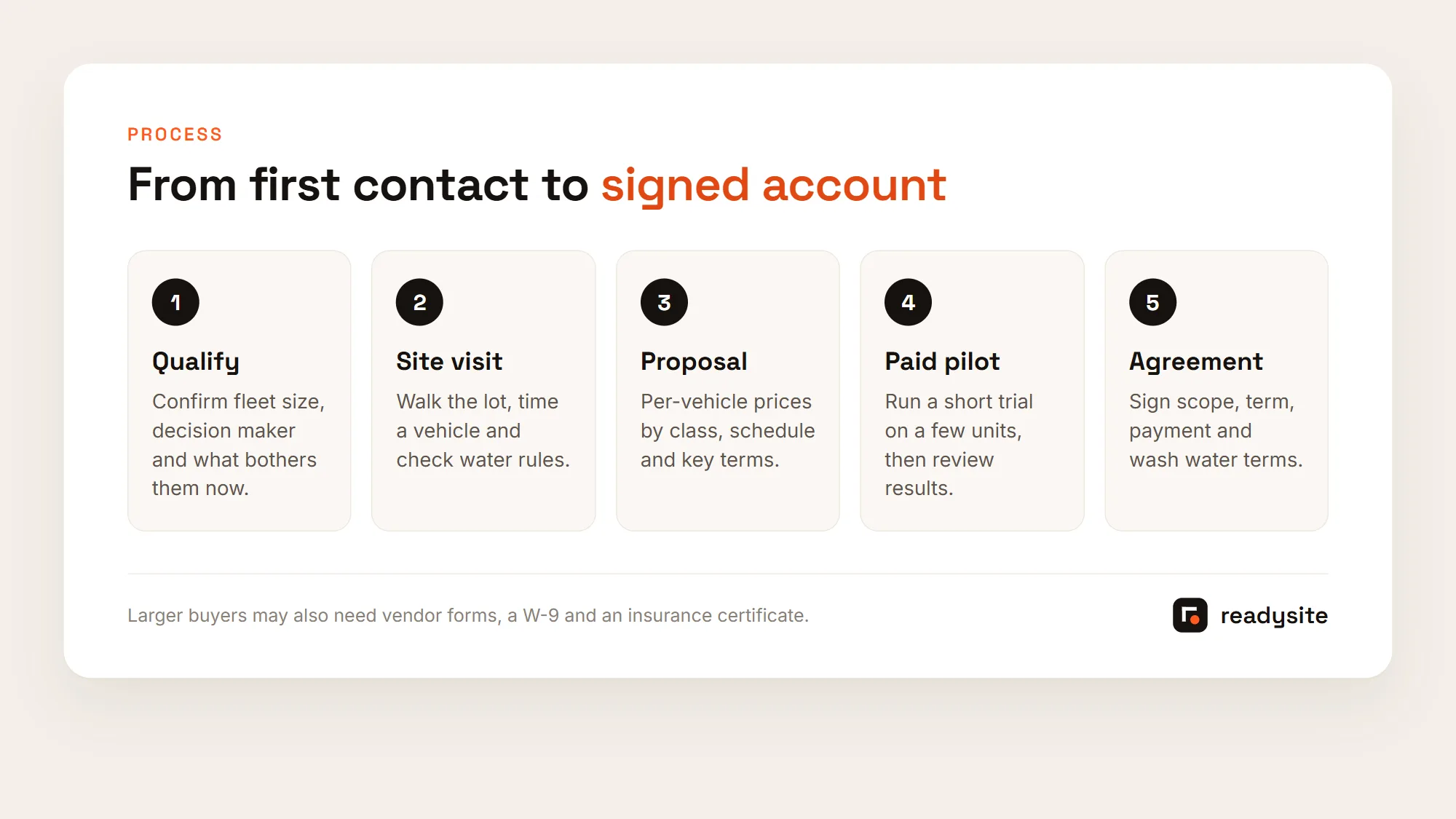
Start new commercial accounts with a short paid pilot, for example two or three visits, before a long term. It lets both sides check timing, quality and logistics without a big commitment. Then move to a 6 or 12 month agreement with a notice period, so neither side is trapped. This is not legal advice. Contract law varies by state, and a local attorney can review your template once so you can reuse it for every account.
Invoicing Terms That Get You Paid
Commercial accounts usually pay on terms, such as net 15 or net 30. Invoice on a fixed schedule and list each vehicle by unit number, date and service. Include the purchase order number if the customer uses them, since invoices without one are often held. Larger customers will ask for vendor paperwork, usually a Form W-9, which the IRS describes on its About Form W-9 page as the form you use to give your correct taxpayer identification number to a business that reports payments to you.
Get the agreement and invoicing right once and all your future fleet detailing contracts become easier. You reuse the same template, the same visit log and the same habits, and you spend your time washing instead of chasing payments.
Fleet Washing Compliance And Keeping Accounts
Fleet washing creates far more wash water than a single detail, often in a parking lot that drains straight to a storm drain. That makes wastewater the compliance issue most likely to cost you an account, or a fine. Once that’s handled, keeping accounts is mostly about being boring in the best way.
Why Wash Water Matters
The EPA explains on its page about stormwater discharges from municipal sources that storm sewer systems often carry runoff to local waters without treatment. Its fact sheet on vehicle and equipment washing says wash water can carry sediment, detergents, oils, grease and heavy metals. It recommends containing, treating or reusing it, for example with a bermed wash area and a wet/dry vacuum to capture water for discharge to the sanitary sewer with the sewer authority’s permission.
Find The Rule That Applies To You
Call or search your city or county stormwater program, often part of public works, and ask about mobile vehicle washing. Ask the local sewer authority whether, where and how you may discharge captured wash water. Ask the property owner or fleet manager about any site rules for the lot. Then write what you learn into the agreement. Rules differ a lot between cities, so don’t assume what’s allowed in one town applies in the next. This is not legal advice; confirm with your local agencies before you start.
Be Reliable And Keep Records
Same day, same time, same quality. Keep a visit log with photos, so you can answer “was unit 14 done?” in seconds. Send a short report after each visit or each month listing vehicles done, issues you noticed like a cracked mirror or a leaking tire, and anything skipped and why. Use the same crew on the same account when you can, because fleet managers like familiar faces. If weather or staffing will delay a visit, tell the customer before they notice.
Review Quarterly And Ask For Referrals
Every few months, ask what’s working, what isn’t, and whether vehicles have been added. Suggest interior work or wrap protection only when it solves a real problem you’ve seen. Fleet customers also refer you. A happy fleet manager knows other fleet managers, and a dealership’s staff often book retail details for their own cars. Ask, just as you would with retail customers. If you also sell recurring retail plans, our guide to detailing membership plans covers scheduling that applies here too.
Handle the water properly and show up like clockwork, and you give commercial accounts every reason to stay. A steady fleet washing route is what makes the early starts worth it.
Conclusion
Most fleet detailing contracts start the same way: one yard, one walk-through and a clear proposal. This week, list ten fleets you see in your area and send three short messages asking for a site visit. Bring a scoping checklist, time one vehicle, and build your price per vehicle class from your own numbers. Put the scope, schedule, wash water handling and payment terms in writing, start with a short paid pilot, and check your local stormwater rules before the first wash.
Want your website to look ready for commercial accounts without building it yourself? Request a free preview of a done-for-you site with a fleet services section. ReadySite’s done-for-you option is $299 one time for up to 5 pages with the wording written for you, and you only pay if you like it.
Done-for-you websites
Want your website built for you?
ReadySite writes the wording, builds up to 5 pages and sets up your Google Business Profile. $299 one time, and you see a free preview before you pay.