Detailing Website Copy: Fill-in Templates for Every Part of Your Site
Fill-in copy templates for each part of a detailing website, from the homepage hero to services, packages, service area, FAQ and calls to action, with before and after rewrites.


Good detailing website copy answers four questions in plain words before a visitor scrolls: what you do, where you do it, roughly what it costs, and how to book. Everything else on the site, from services and packages to your service area, process and FAQ, adds detail to those four answers. The templates below give you a fill-in formula for each section, with example wording you can adapt in an afternoon.
This guide is about the words on your homepage and other pages, not the layout. If you’re still deciding which sections your site needs and in what order, start with our guide to car detailing website design, then come back here to write each part. All example copy uses made-up towns, names and placeholder prices like $X. Replace them with your own details, and only keep claims that are true for your business.
Need the website first? You can build a free car detailing website in a few minutes, with your packages, prices and a quote button, or start from a detailing template.
Why Specific Detailing Website Copy Matters
Most detailer sites say the same things: “passionate about cars,” “attention to detail,” “quality service at affordable prices.” Those lines aren’t wrong. They just don’t help anyone decide, because every competitor says them too. Specific website copy wins because it gives the reader something to act on, and a few simple rules get you most of the way there.
Specific Beats Impressive
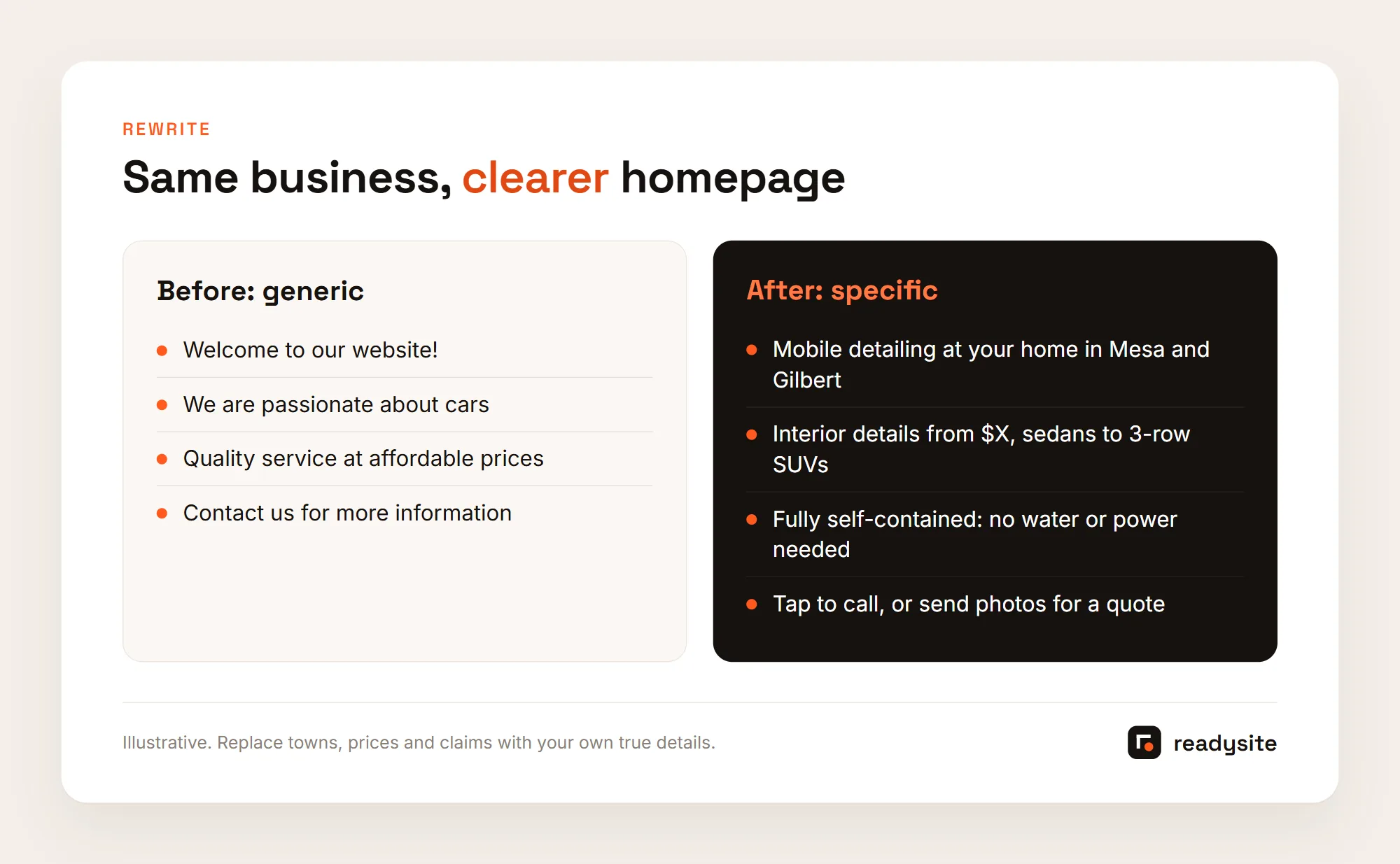
“We remove pet hair from every seat and carpet, then vacuum the vents” is more convincing than “unmatched interior care.” Name the tasks, the towns, the vehicle sizes and the time it takes. Specific details also help Google understand your pages. Its guidance on helpful, people-first content asks whether content offers original information and leaves readers satisfied, not whether it repeats the same phrases as everyone else. A line only you could write is worth more than a polished line anyone could paste onto their site.
Write For A Phone And End With A Next Step
Most people will read your homepage on a phone, often in a parking lot or on a couch. Use short paragraphs, plain words and one idea per sentence. If a paragraph runs past four lines on your phone screen, split it. And don’t make anyone hunt for your number. A visitor who’s convinced halfway down the page shouldn’t have to scroll back up to find it, so end each major section with a link or button to call, text or request a quote.
Only Say What You Can Back Up
The FTC’s Advertising FAQs for small business explain that ads must be truthful and not misleading, and that you need evidence for your claims before you publish them. That applies to your website copy too. Avoid “best in town,” “lasts forever” or “guaranteed” unless you can prove it, and describe coating durability the way the product maker does. This is not legal advice. Honest, checkable claims also hold up better when a customer compares your site with what actually happens on the day.
Done-for-you websites
Want your website built for you?
ReadySite writes the wording, builds up to 5 pages and sets up your Google Business Profile. $299 one time, and you see a free preview before you pay.
How Do You Write A Homepage Hero And Services That Get Calls?
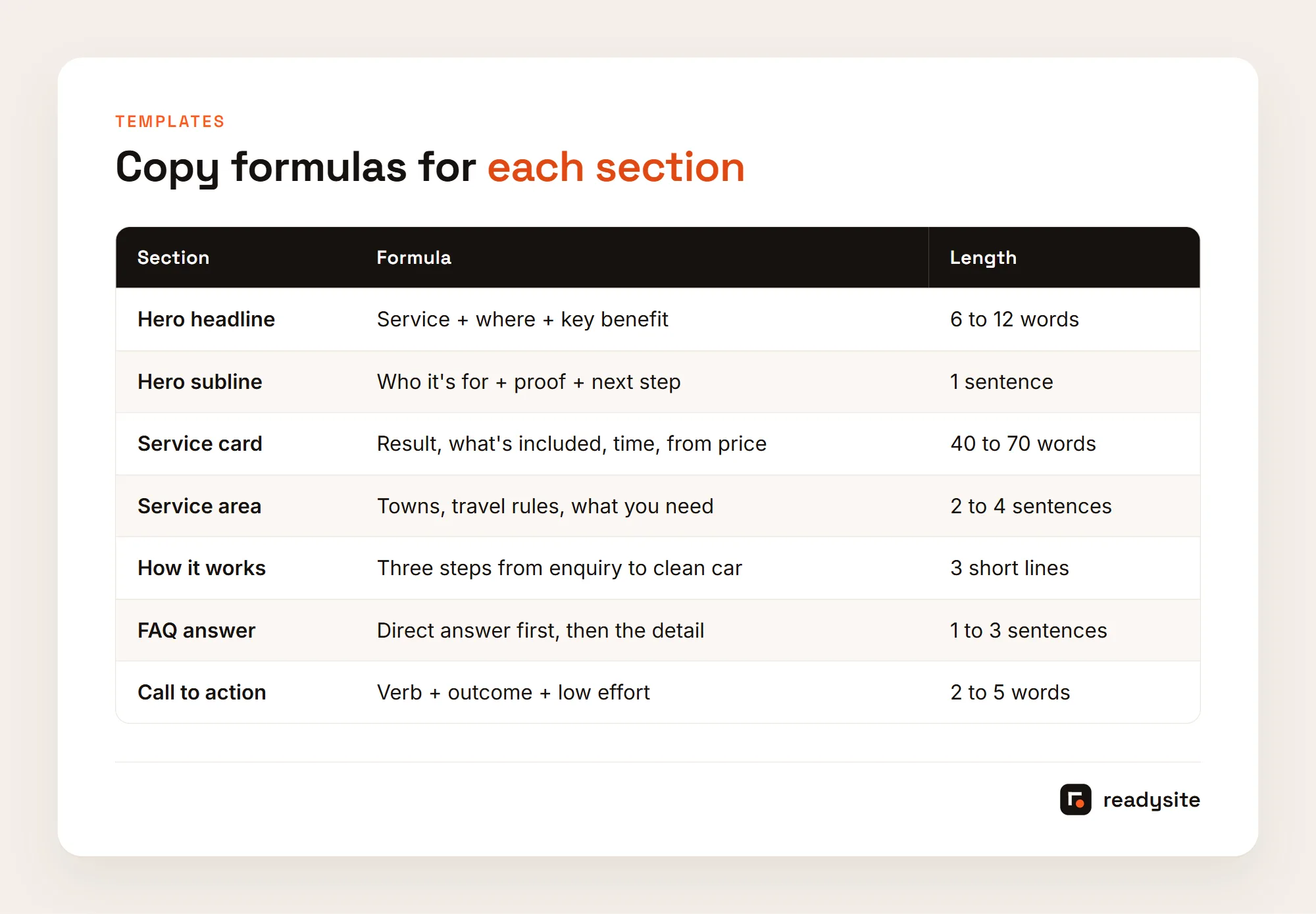
The hero is the first screen of your homepage, and it has about three seconds to tell someone they’re in the right place. Service descriptions come right after, and they do the heavy lifting in your detailing website copy. Use one formula per section and keep to a sensible length.
Headline Formula: Service, Where, Key Benefit
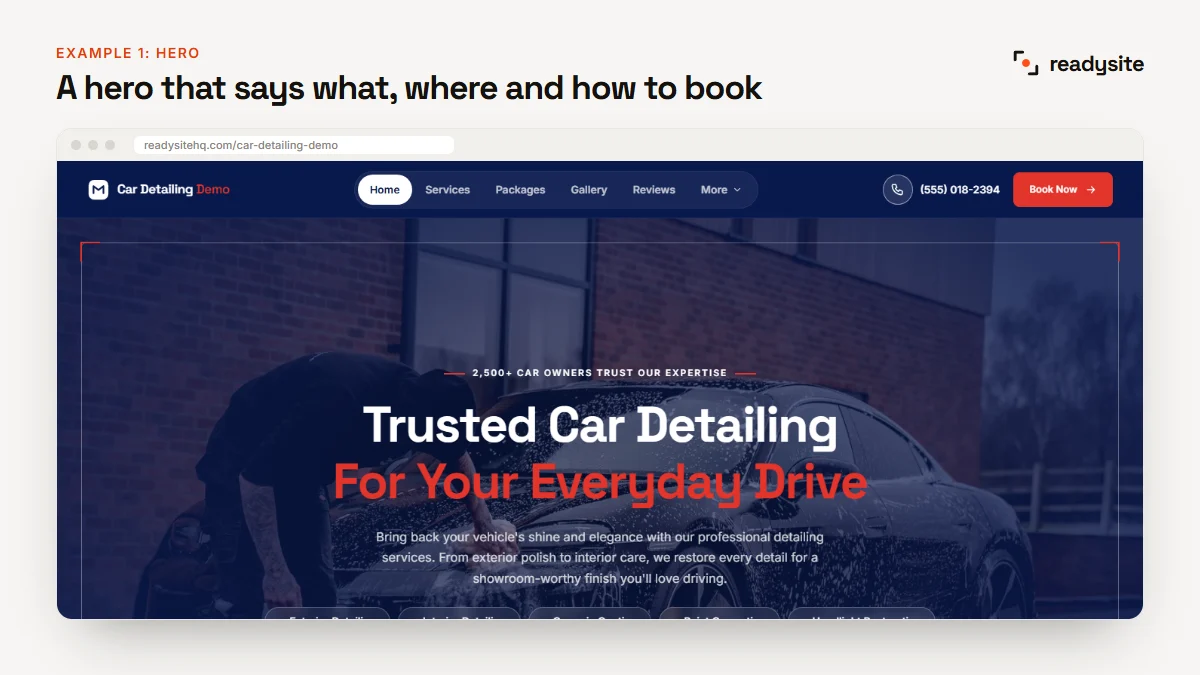
Your hero has three parts: a headline, a one-sentence subline and one or two buttons. The headline names the service, the place and one benefit. Illustrative examples: “Mobile car detailing in Mesa and Gilbert, done at your driveway,” “Interior and exterior detailing for busy families in [town]” or “Ceramic coating and paint correction in [county], by appointment.” Keep the headline at the top of your homepage to a line or two on a phone. Anyone who reads only the headline should still know what you do and whether you cover their area.
Subline And Button Labels
The subline says who it’s for, adds proof and points to the next step: “For commuters, parents and pet owners who want a clean car without the trip. Fully insured, [number] five-star Google reviews. Send a few photos and get a price today.” Only include the review count if it’s current, and update it as it changes. For buttons, pick verbs that say what happens: “Call now,” “Get a quote,” “Text us photos,” “See prices.” Avoid “Submit” and “Learn more,” which tell the visitor nothing. With two buttons, make one main and one secondary.
Service Card Formula
Each service description in your website copy should answer what the car will look like after, what exactly you do, how long it takes and roughly what it costs. Start with the service name and one sentence on the result, then list what’s included, the time and a starting price. An illustrative example: “Full interior detail. For cars that need a real reset: kids, pets, road trips. We vacuum and shampoo seats and carpets, clean vents, cupholders and door pockets, wipe and protect all plastics, and clean the inside of the glass. Takes about 3 to 4 hours. Sedans from $X, SUVs and trucks from $Y.”
Name Services For Customers, Not Detailers
“Two-step machine polish” means something to you. To a customer, “Paint correction: removes swirl marks and light scratches” explains the result first, then the technique. Use your technical terms in the description, not as the only label. The same goes for package names: a customer should be able to tell what they get from the name and one line under it. Our detailing service menu guide covers how to group services and add-ons before you write them up.
Write the homepage hero last, once you know what the rest of the site says. It’s much easier to sum up your business in one line after you’ve written the service cards, because by then you know which services and towns matter most.
How To Write Packages, Area And Process Copy
Once your services are written, the next sections answer the practical questions: which package should I pick, do you come to my area, and what happens after I contact you? This part of your website copy is often skipped or rushed, but it’s where many customers decide whether to book.
Packages And Pricing Copy
Package copy has one job on your homepage or services page: help people choose quickly. Offer two to four packages, each with a plain name like Maintenance, Full Detail or Reset, a one-line “best for,” four to six short inclusions and a “from” price by vehicle size. Add a line of fine print on what changes the price, such as “Heavy pet hair or stains may add time.” Show prices or ranges. “Call for pricing” makes many people leave to find someone who shows a number. For price research, see our guide to car detailing prices.
Service Area Copy
Mobile detailers need a clear service area section, and many skip it. List the towns by name, explain travel rules and say what you need on site. Illustrative example: “We come to you in Mesa, Gilbert, Chandler and Queen Creek. Outside those areas? Send your ZIP code; a travel fee may apply. We bring our own water and power.” Only claim that if you really carry them. Naming real towns in plain text also helps people searching in those places, and our guide to car detailing SEO explains the rest.
How It Works In Three Steps
People booking a mobile service for the first time want to know what happens. Three steps is enough. First, tell us about your car: call, text or send the quote form with a few photos. Second, get a price and a time: we confirm the price and book a slot that suits you. Third, we come to you: you carry on with your day and we text you when the car is ready. Match the steps in your website copy to what you actually do. If you take a deposit or need the keys, say so in the right step.
A Short About Section
Your About section, on the homepage or its own page, is where a small detailing business has an advantage over big chains: you’re a real person. Keep it to four or five sentences covering who you are, how you got into detailing, what you care about in the work, where you’re based and one personal detail. Illustrative example: “I’m Dan, and I started detailing my dad’s truck at 15. I opened Ridgeway Car Care after two years at a local shop. I take my time on interiors, because that’s what you see every day.” Add a real photo of you with your setup.
Honest process and area copy prevents more wasted trips and no-shows than any reminder system. If something about your service is unusual, like needing an outlet or a covered spot, these sections are the place to say it.
Writing Proof, FAQ And Contact Copy
The last sections of your site build trust and close the deal. They need the same plain, specific style as the rest of your detailing website copy, plus extra care with anything that sounds like a promise or a review.
Reviews And Before And After Photos
Use exact quotes from genuine reviews with the reviewer’s first name and the service they booked, and link to your Google profile from your homepage so people can read the rest. Don’t write reviews yourself, edit them to sound better, or present a few hand-picked quotes as if they were all your reviews. The FTC’s Consumer Reviews and Testimonials Rule Q&A covers fake reviews and review suppression. For earning more honest reviews, see our guide to detailing reviews.
Before and after photos are proof too. Caption each with the vehicle, service and town, like “2019 Honda Pilot, full interior detail, Chandler.” Our guide to before and after detailing photos covers angles and honest editing. Use your own photos only, and don’t edit them in a way that makes the result look better than it was.
FAQ Answers That Start With The Answer
A good FAQ answers the questions people ask you on the phone, which makes it some of the most useful website copy you will write. Lead with the direct answer. “Do I need to be home?” “No, as long as we can reach the car and you leave it unlocked or hand us the keys.” “What if it rains?” “We’ll text you to move your appointment at no charge.” “Can you get out pet hair, stains or smoke smell?” “Usually we can greatly improve them. Send photos and we’ll tell you honestly what to expect.” That last answer builds more trust than promising a perfect result.
Calls To Action And Form Copy
Your closing section should make booking feel easy. Combine a short line of reassurance with your contact options. Illustrative example: “Ready for a clean car without the trip? Call or text [number], or send a few photos through the form and we’ll reply with a price, usually the same day.” Only promise a reply time you can keep, even on your busiest days.
The form needs its own copy too: a friendly heading, a line explaining why you ask for photos, and a confirmation message that says what happens next. A call to action belongs at the end of every page of your website copy, not just the contact page. Our guide to the detailing quote form covers fields, wording and auto-replies in detail.
Proof, FAQ and contact copy work as a set at the bottom of your homepage. Reviews make people believe you, FAQs remove the last doubts, and the call to action gives them one easy way to act on both.
Rewriting Common Detailing Website Copy Lines
The fastest way to improve detailing website copy is to find the vague lines you already have and rewrite them. Here are lines that appear on the homepage of many detailer sites, with an illustrative rewrite for each. Swap in your own facts.
“Welcome To Our Website!”
Rewrite it as “Mobile detailing at your home or office in Mesa, Gilbert and Chandler.” The visitor already knows they’re on your website. The top of your homepage is the most valuable space you have, so use it to say what you do and where. A welcome line spends that space on nothing. If a visitor reads only this one line before deciding whether to stay, it should tell them they’ve found a detailer who serves their area.
“We Are Passionate About Cars.”
Rewrite it as “Every interior gets a seat-by-seat shampoo, vents cleaned and glass streak-free, or we come back and fix it.” Passion is shown by what you do, not by saying the word. If you offer a re-do policy, this is the place to state it, along with any limits. The same applies to “We use only the best products.” Try “pH-neutral soaps on coated cars, and a separate wash mitt for wheels so grit never touches your paint.” Name the practice and why it matters.
“Quality Service At Affordable Prices.”
Rewrite it as “Maintenance washes from $X, full details from $Y. Prices by vehicle size, shown below.” “Affordable” means something different to everyone, and “quality” is something every competitor claims. A real number lets people decide for themselves, and it filters out enquiries from people looking for a much cheaper service. If your prices depend on condition, keep the “from” and add a short note on what moves the price, so nobody feels misled when the quote arrives.
“Contact Us For More Information.”
Rewrite it as “Text a few photos to [number] and get a price, usually within the hour on working days.” Only state a reply time you actually keep. A clear next step turns website copy into enquiries. A vague one leaves people to decide later, and many never come back. Run the same test on every line of your homepage: if a competitor could paste it onto their site without changing a word, rewrite it with a detail only you can claim.
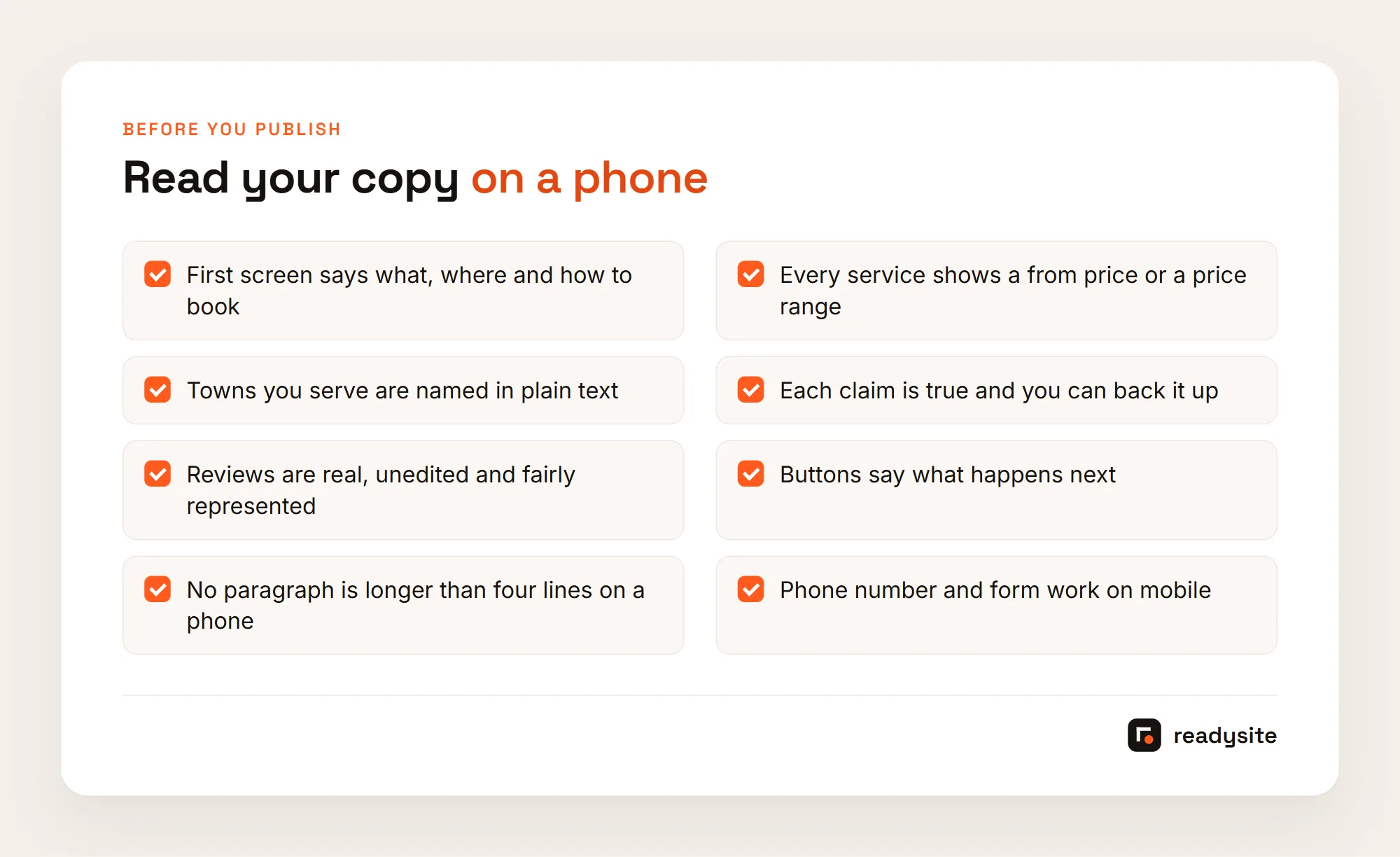
Write your detailing website copy in this order: services, packages, area, process, FAQ and About, then the hero last. Read every page on your phone before going live. To see the sections working together, look at the Apex Auto Detailing example site. Then you can build your car detailing website free with ReadySite, paste in your copy, add photos, and let visitors reach you with click-to-call, WhatsApp or the quote form.
Conclusion
Detailing website copy doesn’t need to be clever. It needs to be specific, true and easy to act on. Start with your three main services and write a service card for each, then your area section and three FAQ answers. Write the homepage hero last, check every claim in your detailing website copy, and read the whole site on your phone. That’s an evening of work, not a month, and it gives every visitor a clear answer to what, where, how much and how to book.
Rather not write it yourself? Request a free preview of a done-for-you site. ReadySite writes the wording for up to five pages, sets up your Google Business Profile, and you only pay if you like the result.
Done-for-you websites
Want your website built for you?
ReadySite writes the wording, builds up to 5 pages and sets up your Google Business Profile. $299 one time, and you see a free preview before you pay.